
Traeger vs Weber in 2026: Woodridge Pro vs Searwood 600
Traeger vs Weber in 2026: The Bottom Line
The Traeger-versus-Weber question has a new answer in 2026, because Weber has a new pellet grill. The SmokeFire — Weber's troubled 2020 entry into pellet cooking — is discontinued, replaced by the ground-up Searwood line launched in 2024. That changes this matchup completely: the Weber Searwood 600 is a far stronger competitor to the Traeger® Woodridge™ Pro than the SmokeFire ever was.
The honest verdict is a split decision, and which side you land on depends on how you cook. If you grill and sear as much as you smoke, buy the Searwood 600 — its 600-degree full-grate DirectFlame sear is something no Traeger at this price can match. If low-and-slow smoking is the main event, buy the Woodridge Pro — Super Smoke Mode, 970 square inches, and the WiFIRE® ecosystem make it the more complete smoker.
Forced to pick one for the typical pellet grill buyer — who, in our experience, buys primarily to smoke — our pick remains the Traeger Woodridge Pro. But the margin is the closest it has ever been, and for a large group of backyard cooks the Weber is now the better buy.
This page matches each brand's mid-tier flagship. If your budget sits nearer $900 than $1,150, the closer price-for-price matchup is the Searwood 600 against Traeger's 860-square-inch entry model — we work that one through in our Weber Searwood 600 vs Traeger Woodridge comparison.
What Happened to the SmokeFire?
If you searched "Traeger vs Weber SmokeFire," here is the short version: Weber no longer makes the SmokeFire. Its January 2020 launch was one of the rockiest in outdoor cooking history — widespread reports of grease fires, flare-ups, auger jams, and software glitches. Weber issued hardware revisions and firmware fixes, but the design's fundamental grease-management problems kept it from ever fully recovering, and Weber quietly discontinued the line.
The Searwood, launched in 2024, is not a SmokeFire update — it is a clean-sheet redesign. The hopper moved to the side, the grill works with any brand of pellets (the SmokeFire was fussy about them), a Pull-and-Clean ash drawer handles cleanup, and the fire and grease systems were re-engineered to eliminate the flare-up-prone architecture. The critical reception tells the story: AmazingRibs awarded the Searwood 600 its Platinum medal. If you were holding off on Weber pellet grills because of the SmokeFire's reputation, the Searwood is the reason to look again. Weber also sells a smoke-focused line without the sear, the Smoque; our Weber Smoque review covers who should choose it over the Searwood.
Side-by-Side Specifications
| Feature | Traeger Woodridge Pro | Weber Searwood 600 |
|---|---|---|
| Rating | 4.5 | 4.6 |
| Price | $1,149.99 · View on Amazon Price as of October 15, 2026 | $999.00 · View on Amazon Price as of October 15, 2026 |
| Cooking Area | 970 sq in | 648 sq in (420 + 228) |
| Hopper Capacity | 24 lbs | 20 lbs |
| Max Temperature | 500°F | 600°F (180–600°F range) |
| Controller Type | Digital PID | Rapid React PID |
| WiFi Connectivity | WiFIRE® (full app control) | Weber Connect (WiFi + Bluetooth, no remote-start) |
| Warranty | 10-year | 5-yr cookbox / 3-yr electronics |
| Weight | ~150 lbs | 125.4 lbs |
| Construction | Steel with powder coat | Cast-aluminum cookbox |
| Searing Capability | 500°F max (indirect) | 600°F full-grate DirectFlame |
| Ash Cleanout | EZ-Clean Grease & Ash Keg | Pull-and-Clean ash drawer |
| Enhanced Smoke Mode | Super Smoke Mode | SmokeBoost (180°F) |
| Meat Probes | 1 wired probe included | 2 wired probes included |
#ad — the price buttons are affiliate links and we may earn a commission at no extra cost to you. Prices come from Amazon at the time stamped on each button; the live Amazon price always wins. See our affiliate disclosure.
Traeger Woodridge Pro Overview
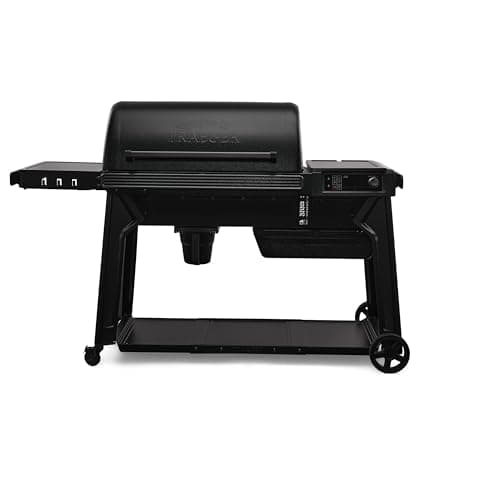
The Traeger® Woodridge™ Pro represents Traeger's mid-range sweet spot — a grill that delivers premium features without premium pricing. At $1,149, it provides 970 square inches of cooking space, WiFIRE® connectivity, Super Smoke Mode, and a 10-year warranty backed by a company that has been building pellet grills since 1985.
Traeger's advantage in this matchup is straightforward: decades of experience in pellet grill design, an unmatched app ecosystem, and a mature, proven fire-management system. The Woodridge Pro is not Traeger's flagship — that honor belongs to the Timberline — but it incorporates lessons learned across four decades of pellet grill engineering into a package that works consistently and well. Cleanup runs through the EZ-Clean Grease & Ash Keg, which combines grease and ash disposal into a single container.
Super Smoke Mode is particularly relevant in this comparison. Weber designed the Searwood first as a grill; Traeger's DNA is rooted in smoking. Super Smoke amplifies that heritage by increasing smoke output at temperatures below 225 degrees, producing brisket and ribs with more pronounced smoke flavor than standard pellet grill operation. For a closer look at the Woodridge platform, see our Traeger Woodridge 850 review.
Weber Searwood 600 Overview
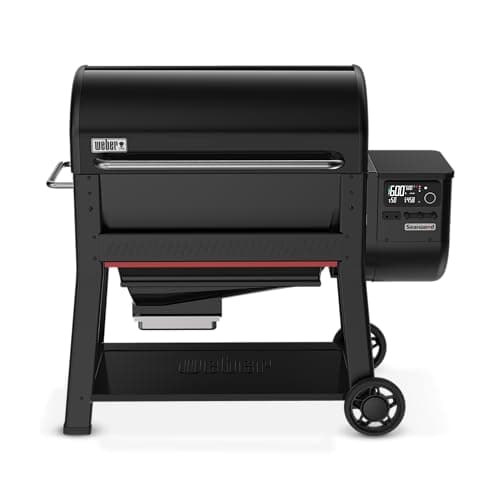
The Weber Searwood 600 is the pellet grill Weber should have built the first time. At $999 on weber.com, it offers 648 square inches across a 420 square inch main grate and 228 square inch upper rack, a 20-pound hopper, and a 180-to-600-degree operating range.
The headline feature is DirectFlame: stainless steel Flavorizer bars sit over an open firepot, letting flame reach the entire main cooking grate. AmazingRibs, which gave the Searwood its Platinum medal, confirmed "a true 600°F across the entire grate" — not a token sear zone in one corner. They also praised "some of the best smoke quality we've experienced from a pellet burner," which undercuts the assumption that a sear-first pellet grill must smoke poorly. Smoked BBQ Source rated it 4.5/5, clocking 600 degrees in 13 minutes with the Rapid React PID holding within 5 degrees of target.
The rest of the package is thoughtful: Weber Connect app control over WiFi and Bluetooth (though no remote-start), a Manual Mode for open-lid cooking, a 180-degree SmokeBoost mode, two included probes, and a weatherproof cast-aluminum cookbox that keeps the whole grill to 125.4 pounds. Warranty coverage runs 5 years on the cookbox and 3 years on electronics. The reviewer gripes are minor: shelves cost extra, it runs about 15 degrees under the dial, there are no casters, and Smoked BBQ Source noted the right side runs hotter with roughly a 50-degree front-to-back gradient. One buying note: the Searwood is effectively a weber.com purchase (also stocked at Lowe's, Ace, and BBQGuys) — Amazon's listing is unavailable. Our full Weber Searwood 600 review covers it in depth.
Head-to-Head: Searing and High-Heat Grilling
This is the Searwood's strongest category, and where Weber's grill-first design philosophy pays off.
Weber Searwood 600: The 180-to-600-degree range with full-grate DirectFlame searing is the best high-heat story in this price class. AmazingRibs measured a true 600 degrees across the entire grate, and Smoked BBQ Source hit 600 degrees in 13 minutes. Because the stainless Flavorizer bars sit over an open firepot, the whole main grate sears — you are not shuffling steaks through a single hot zone. Manual Mode even allows open-lid, hibachi-style cooking.
Traeger Woodridge Pro: The Woodridge Pro maxes out at 500 degrees with indirect heat only. You can achieve a decent sear at 500 degrees on preheated grates, but it will not match the Searwood's intensity or speed. For serious searing, Traeger requires you to step up to the Woodridge Elite ($1,799), which adds a side sear station.
For steaks, burgers, and anything that benefits from a hard, fast sear, the Searwood has a genuine, measurable advantage — it currently tops our best pellet grills for searing rankings.
Winner: Weber. A verified 600 degrees across the whole grate beats 500 degrees of indirect heat, full stop.
Head-to-Head: Smoking Performance
This is Traeger's strongest category, though the gap is smaller than it was in the SmokeFire era.
Traeger Woodridge Pro: Smoking is Traeger's heritage, and the Woodridge Pro delivers. The digital PID controller holds low-and-slow temperatures steady, and Super Smoke Mode increases smoke output below 225 degrees, producing a more pronounced smoke ring, deeper bark, and richer flavor on brisket, pork butt, and ribs. The 970 square inches means large cooks run without crowding.
Weber Searwood 600: The Searwood smokes better than a sear-focused grill has any right to. Its SmokeBoost mode runs at 180 degrees for heavier smoke early in a cook, and AmazingRibs — not a publication given to hyperbole — reported "some of the best smoke quality we've experienced from a pellet burner." The limitations are capacity (648 square inches fills up fast with a packer brisket and sides) and the lack of a Super Smoke equivalent across the broader low-temperature band.
If smoking is why you are buying a pellet grill, the Traeger's dedicated smoke mode, larger chamber, and smoking-first pedigree still make it the better tool. But the Searwood is no longer the compromise the SmokeFire was.
Winner: Traeger. Super Smoke Mode and 40 years of smoking-first engineering keep the edge — narrowly.
Head-to-Head: Cooking Space and Capacity
The numbers here are straightforward and favor Traeger significantly.
Traeger Woodridge Pro: 970 sq in. This accommodates a full packer brisket plus two racks of ribs, five racks of baby backs, or 22-24 burgers. It comfortably feeds 10-16 people in a single cook. The 24-pound hopper also runs longer between refills.
Weber Searwood 600: 648 sq in (420 + 228). The 420 square inch main grate fits a packer brisket or three racks of baby backs, with the 228 square inch upper rack for sides and warming. The 20-pound hopper is adequate for overnight cooks. This is a household-of-four-to-eight grill, and note that side shelves are a paid add-on.
That is roughly 50% more cooking space on the Traeger. For weeknight dinners, both are more than adequate. For hosting, parties, or big-batch cooks, the Traeger's extra space is a significant practical advantage. (Weber does sell the larger Searwood 600 XL for buyers who need more room, at a higher price.)
Winner: Traeger. Over 300 more square inches is decisive for anyone who cooks for groups.
Head-to-Head: App Ecosystem and Connectivity
Both grills offer WiFi connectivity, and this category is much closer than it was in the SmokeFire days.
Traeger WiFIRE®: Still the gold standard for pellet grill apps. Remote temperature control, real-time probe monitoring, custom alerts, firmware updates, cook history, and a deep recipe library. The app is fast, reliable, and genuinely useful as a cooking tool — set-and-forget works as advertised, including starting adjustments from the couch.
Weber Connect: Dramatically improved. In Smoked BBQ Source's Searwood testing, the WiFi connection "worked flawlessly" — a sentence nobody wrote about the SmokeFire. The app handles remote monitoring, temperature changes mid-cook, and Weber's step-by-step grilling assistant, a guided cooking feature that is genuinely helpful for beginners. The one real gap: there is no remote-start, so every cook begins at the grill.
Winner: Traeger. WiFIRE's depth, recipe library, and remote control still lead, but Weber Connect has closed most of the reliability gap.
Head-to-Head: Build, Cleanup, and Warranty
Build: The Searwood's cast-aluminum cookbox is weatherproof, corrosion-resistant, and keeps the grill to a manageable 125.4 pounds — classic Weber kettle DNA. The Woodridge Pro uses powder-coated steel at roughly 150 pounds. Both are solidly built; the Searwood's material choice is the more weather-durable of the two, though AmazingRibs dinged it for lacking casters.
Cleanup: Traeger's EZ-Clean Grease & Ash Keg combines grease and ash into one dump-and-done container and remains the most convenient system in the industry. The Searwood's Pull-and-Clean ash drawer is a huge improvement over the SmokeFire (which made you vacuum ash from the cookbox) but still separates grease and ash handling.
Warranty: Traeger covers the Woodridge Pro for 10 years. Weber covers the Searwood cookbox for 5 years and electronics for 3. Weber's kettle warranties are legendary; its pellet grill coverage is not, and Traeger's decade of coverage is the stronger promise.
Winner: Traeger, narrowly — on cleanup convenience and warranty length, with build quality essentially a wash.
Who Should Buy the Traeger Woodridge Pro
The Traeger Woodridge Pro is the right choice if you:
- Prioritize smoking — Super Smoke Mode and Traeger's smoking heritage deliver superior low-and-slow results
- Need more cooking space — 970 sq in versus 648 sq in is a substantial difference
- Host large gatherings — Briskets, ribs, and sides all fit in a single cook
- Value the deepest app experience — WiFIRE remains the most refined pellet grill connectivity system, remote-start included
- Want the simplest cleanup — The EZ-Clean Grease & Ash Keg is unmatched for convenience
- Want the longest warranty — 10 years versus Weber's 5/3-year coverage
Who Should Buy the Weber Searwood 600
The Weber Searwood 600 is the right choice if you:
- Prioritize searing — A verified 600°F across the entire grate beats any standard pellet grill, Traeger included
- Grill as much as you smoke — DirectFlame plus Manual Mode makes it the most versatile griller in this price range
- Want strong smoke quality anyway — SmokeBoost and AmazingRibs-praised smoke output mean you give up less than you would expect
- Cook for a smaller household — 648 sq in with an upper rack covers families of four to eight
- Want to spend under $1,000 — At $999 it undercuts the Woodridge Pro by $150 and leads our best pellet grills under $1,000 shortlist
- Prefer Weber's build approach — A weatherproof cast-aluminum cookbox at a liftable 125.4 lbs
Frequently Asked Questions
Can the Weber Searwood sear?
Yes — searing is the Searwood's headline feature. Its DirectFlame system places stainless steel Flavorizer bars over an open firepot, so flame reaches the entire main grate rather than a small sear zone. AmazingRibs, which awarded the Searwood its Platinum medal, confirmed a true 600 degrees across the entire grate, and Smoked BBQ Source clocked it reaching 600 degrees in 13 minutes. The Traeger® Woodridge™ Pro tops out at 500 degrees with indirect heat, which produces an adequate sear but cannot match the Searwood's intensity.
Which produces more smoke flavor — the Searwood 600 or the Woodridge Pro?
The Traeger Woodridge Pro has the edge for dedicated low-and-slow cooks thanks to Super Smoke Mode, which increases smoke output at temperatures below 225 degrees for a more pronounced smoke ring and deeper flavor on brisket, ribs, and pork butt. That said, the Searwood is no slouch: it offers a 180-degree SmokeBoost mode, and AmazingRibs praised some of the best smoke quality they have experienced from a pellet burner. If smoking is your primary use case, choose the Traeger; if you split time between grilling and smoking, the Searwood covers both well.
What happened to the Weber SmokeFire?
Weber discontinued the SmokeFire. Its 2020 launch was plagued by grease fires, flare-ups, and software problems, and rather than keep patching that design, Weber replaced it with the ground-up Searwood line in 2024. The Searwood moves the hopper to the side, works with any brand of pellets, adds a Pull-and-Clean ash drawer, and re-engineers the grease and fire management that made the SmokeFire flare-up prone. Reviewers have received it far better — AmazingRibs gave the Searwood 600 its Platinum award.
Which has a better app — Weber Connect or Traeger WiFIRE?
Traeger's WiFIRE® app remains the deeper ecosystem, with remote temperature control, a large recipe library, cook history, and firmware updates. Weber Connect has improved substantially since the SmokeFire era — in Smoked BBQ Source's Searwood testing the WiFi connection worked flawlessly — and it includes a useful step-by-step grilling assistant. Its one notable gap is that the Searwood cannot be started remotely; you must begin the cook at the grill. For overall app depth, Traeger still leads, but the gap is narrower than it used to be.
Is the Traeger Woodridge Pro worth $150 more than the Weber Searwood 600?
It depends on how you cook. The Woodridge Pro's $1,149 buys 970 square inches versus 648, a 24-pound hopper versus 20, Super Smoke Mode, the WiFIRE ecosystem, and a 10-year warranty versus Weber's 5-year cookbox and 3-year electronics coverage. The Searwood's $999 buys a genuine 600-degree full-grate sear the Traeger cannot match, plus two included probes and a weatherproof cast-aluminum cookbox. Smoke-first cooks and party hosts should pay the extra $150; grill-first cooks should keep it and buy the Searwood.
Our Recommendation
For the smoke-first buyer — which is most pellet grill buyers — the Traeger® Woodridge™ Pro is still our pick. Super Smoke Mode, 50% more cooking space, the deepest app ecosystem in the category, one-container cleanup, and a 10-year warranty justify its $1,149 price for anyone whose weekends revolve around brisket and ribs.
For the grill-first buyer, the recommendation flips. The Weber Searwood 600 is the redemption arc Weber needed: a verified 600 degrees across the entire grate, smoke quality that impressed AmazingRibs enough for a Platinum medal, a flawless WiFi showing in Smoked BBQ Source's testing, and a $999 price. If steaks, burgers, and weeknight versatility drive your cooking — with real smoking capability held in reserve — the Searwood is the better grill, and this is the first time we have been able to say that about a Weber pellet grill. See how it stacks up against another $999 rival in our Searwood vs Camp Chef Woodwind comparison.
Our Pick for Smokers: Traeger Woodridge Pro
More cooking space, Super Smoke Mode, WiFIRE® connectivity, and a 10-year warranty. The Woodridge Pro is the more complete low-and-slow pellet grill at $1,149.
Best for Searing: Weber Searwood 600
A verified 600°F across the entire grate with DirectFlame, SmokeBoost, and Weber Connect — the best searing pellet grill under $1,000.
Explore more: Weber Searwood 600 Review | Traeger Woodridge 850 Review | Searwood vs Camp Chef Woodwind | Best Pellet Grills for Searing | Best Weber Pellet Grill | Weber Smoque vs Traeger Westwood | Best Pellet Grills Under $1,000