
Best BBQ Rub in 2026: 7 Store-Bought Rubs Worth Buying
A rub is the cheapest upgrade in barbecue. A grill is a once-a-decade decision and a bag of pellets is a once-a-month one, but the bottle in your hand is what actually touches the meat — and swapping a tired supermarket blend for a well-built competition rub changes more about how dinner tastes than any accessory you can bolt onto a grill.
The problem is that the rub aisle is almost pure marketing. Bottles shout "championship," "award-winning," and "pitmaster" while the label on the back tells a much plainer story: salt, sugar, paprika, and whatever the brand chose to add after that. So this guide is built around the back of the bottle. Every pick below was verified live and in stock on August 12, 2026, every ingredient claim comes from what the manufacturer itself publishes, and every entry says plainly where the rub falls short. Prices move constantly — the cards show the live price, and we've kept the numbers out of the prose on purpose.
What Actually Separates a Good Rub From a Bad One
Four things decide whether a bottle earns its shelf space, and none of them is the word "championship" on the front:
- Where salt and sugar sit in the ingredient list. Ingredients are listed by weight, so the first two tell you what you're really buying. A rub that leads with salt is a seasoning; a rub that leads with sugar is a bark builder. Both are legitimate — but if salt is first and you also brine or salt your meat separately, you will over-salt the cook.
- Sugar content versus your cooking temperature. This is the one that ruins more cooks than anything else. Sugar caramelizes and then burns well below searing heat, so a sweet rub is a low-and-slow tool. At 225°F to 275°F it becomes bark. On a 500°F sear zone it becomes soot. A sugar-free blend solves that, which is why serious cooks own one of each.
- Grind and texture. A coarse grind sits up on the surface and survives a long smoke; a fine powder dissolves into the meat and disappears faster. Coarse rubs are better for beef and thick cuts, fine ones for poultry and quick cooks.
- Cost per ounce, not cost per bottle. Rub bottles vary wildly in size — some of the picks here are 11 ounces, one is 26 — so the sticker price is close to meaningless on its own. The big-bottle picks below cost noticeably less per ounce, which matters if you season more than a few cooks a month.
One more filter we applied: does the brand publish its full ingredient list? Most of the picks here do. Where a brand keeps the blend vague, we say so.
Quick Picks: Best BBQ Rubs
| Award | Rub | Best For | What the brand states it is |
|---|---|---|---|
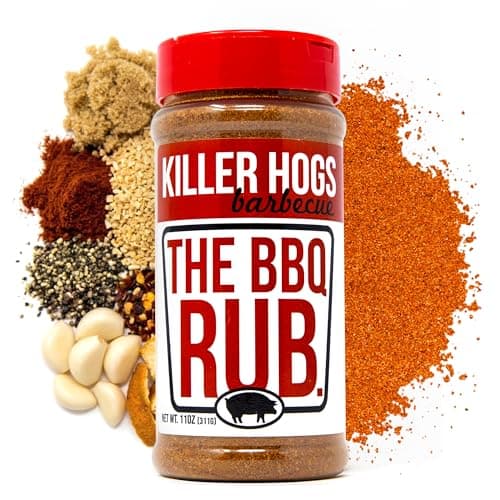
| Best Overall | Killer Hogs The BBQ Rub | Pork, chicken, everything | Brown sugar and sugar first, then paprika, salt, red and black pepper, garlic, orange peel |
| Best for Brisket & Beef | Hardcore Carnivore Black | Brisket, steak, prime rib | Sea salt, sugar, black pepper, garlic and onion, chili powder, activated charcoal |
| Best Simple SPG | Lane's SPG | Texas-style brisket, steaks, burgers | Coarse salt, pepper, garlic — sugar-free, gluten-free, no MSG |
| Best for Ribs & Pork | Heath Riles BBQ Honey Rub | Ribs, pork, chicken | Sugar, salt, dehydrated honey, paprika, garlic, spices |
| Best for Chicken & Wings | Kosmos Q Dirty Bird | Wings, whole birds, turkey | Salt, sugar, chili pepper, brown sugar, paprika, garlic, onion |
| Best Value / No Sugar | Bad Byron's Butt Rub | High heat, pork butt, all-purpose | Salt, black pepper, onion, garlic, paprika, chipotle — no sugar, no MSG |
| Best Grocery-Aisle Backup | Traeger® Rub with Garlic & Chili Pepper | Weeknight chicken and beef | Salt, cane sugar, basil, brown sugar, paprika, garlic, chili pepper |
Hardcore Carnivore Black (13 oz)
Lane's SPG (12 oz)
Heath Riles BBQ Honey Rub
Kosmos Q Dirty Bird (11 oz)
Bad Byron's Butt Rub (26 oz)
Traeger® Rub with Garlic & Chili Pepper
How We Judged These Rubs
We don't run a blind tasting panel, and we're not going to pretend we do. This ranking is built from three things we can stand behind: the ingredient lists and product claims each manufacturer publishes itself, verified live retail listings checked the week this was published, and years of cooking on pellet grills — which is where the practical advice about sugar, heat, and timing comes from.
The score attached to each pick is our own editorial rating, not an average of customer stars. It weighs four things: how transparent the brand is about what's in the bottle, how versatile the blend is across proteins, value per ounce, and whether the flavor the label promises matches the ingredients that are actually in it. Where a rub is narrow, we scored it as a specialist rather than penalizing it for not being an all-rounder.
1. Killer Hogs The BBQ Rub — Best Overall
The Killer Hogs The BBQ Rub is the bottle we'd hand to someone who wants to own exactly one rub. It comes out of Malcom Reed's competition team, and unlike a lot of "championship" branding, the ingredient list backs the claim up: brown sugar and sugar, then paprika, salt, red and black pepper, dehydrated garlic, oleoresin paprika, and dehydrated orange peel. The brand's own summary of it — "flavor, balance, sweetness, and a nice little kick at the end" — is an accurate description of what happens on the meat.
Two things stand out in practice. First, sugar leads and salt sits fourth, which means you can lay it on heavily without wrecking the seasoning balance — a real advantage on a thick pork butt where a salt-first rub would be brutal at the same coverage. Second, the paprika and oleoresin paprika combination builds that deep mahogany color competition cooks chase, so ribs come off looking like the photo rather than looking grey. It's the rub we'd reach for on 3-2-1 ribs and pulled pork alike.
The honest catches: it's a sweet rub, so it belongs at smoking temperatures, not on a screaming sear. Push it much past 350°F and the sugar goes bitter before the meat is done. The 11-ounce bottle also isn't the value play here — it costs meaningfully more per ounce than the big-bottle picks below. And "balanced" cuts both ways: if you want an aggressive, peppery Texas profile, this deliberately isn't it.
Pros
- Full ingredient list published — no mystery blend
- Sweet-first, salt-fourth balance lets you season heavily
- Builds the deep mahogany color competition cooks want
- Genuinely all-purpose across pork, chicken, and beef
Cons
- Sugar-forward, so it scorches above roughly 350°F
- Costs more per ounce than the big-bottle picks here
- Too sweet if you want a straight Texas salt-and-pepper profile
2. Hardcore Carnivore Black — Best for Brisket and Beef
Hardcore Carnivore Black is the most distinctive bottle here, and the reason is on the ingredient list: sea salt, white sugar, black pepper, dehydrated garlic and onion, chili powder, activated charcoal, and silicon dioxide. Jess Pryles' brand states plainly that the charcoal is "added for bark and crust" — it's a color and texture ingredient, not a flavor one, and it's what turns a brisket flat genuinely black rather than dark brown.
That sounds like a gimmick and mostly isn't. Bark is as much a visual reward as a textural one, and this is the shortest path to the look people associate with a Texas brisket. The blend itself is salt-and-pepper-forward with a mild chili-powder backbone, so it stays out of the way of beef instead of sweetening it — the brand markets it as "the ultimate rub for beef and red meat," and that's the right lane. Pair it with a grill that holds 225°F for sixteen hours and a hickory-heavy bag from our best wood pellets guide and you've got the whole beef program covered.
The cons are real. It does contain sugar and salt — there's a separate salt-free version of this rub, which tells you the standard one isn't — so it's not a true high-heat searing rub despite the beef branding. The charcoal stains, on cutting boards, on fingers, and on light countertops. And it's a specialist: on chicken or fish, the black crust reads as burnt even when it isn't, which is a strange thing to serve to guests.
Pros
- Publishes the full ingredient list, charcoal included
- Produces the darkest bark of anything here, by design
- Salt-and-pepper-forward — complements beef instead of sweetening it
- Widely available and priced with the mainstream competition rubs
Cons
- Contains sugar and salt, so it still scorches at sear temperatures
- Activated charcoal stains hands, boards, and counters
- Looks burnt on poultry and fish — genuinely a beef specialist
3. Lane's SPG — Best Simple Salt, Pepper, and Garlic
Half of great barbecue is knowing when to stop adding things. Lane's SPG is the classic Texas base — coarse-ground salt, pepper, and garlic, and nothing else — and the brand states it's sugar-free, gluten-free, made without MSG or preservatives. That sugar-free part is the whole argument for it: this is the rub you use when the cook runs hot.
It's the pick for reverse-seared steaks, burgers, and brisket cooked the Texas way, and it's the one bottle here that's equally at home on the griddle or a direct-flame sear zone as it is in a smoker, because there's no sugar to burn. The coarse grind matters too — it stays on the surface through a long cook rather than melting in, which is exactly what you want on a brisket bark. It's also the most useful bottle in the kitchen; salt, pepper, and garlic is a seasoning, not just a barbecue product.
The trade-off is obvious: it's plain by design. There's no paprika for color, no sugar for bark, and nothing sweet to balance heat, so ribs seasoned only with SPG come out savory and pale compared to the competition rubs above. Salt is the first ingredient, so it's easy to over-season if you're heavy-handed or already brining. And you're paying a brand premium for three ingredients you could mix yourself — the convenience is a uniform coarse grind, not a secret.
Pros
- Sugar-free — the safe choice for searing and high-heat cooking
- Coarse grind survives a long smoke instead of dissolving
- Brand states gluten-free, no MSG, no preservatives
- As useful in the kitchen as it is on the grill
Cons
- Plain by design — no color, no sweetness, no bark help
- Salt-first, so it's easy to over-season a brined cut
- You're paying a brand premium for three common ingredients
4. Heath Riles BBQ Honey Rub — Best for Ribs and Pork
Sweet-heat is the classic rib profile, and the Heath Riles BBQ Honey Rub is the cleanest way to get there without wrestling actual honey. The brand's ingredient list runs sugar, salt, dehydrated honey, paprika, dehydrated garlic, spices, and refined soybean oil, and its pitch is precise: sweet honey flavor "without the char you'd get from using natural honey." That's a real problem it solves — liquid honey burns fast and unevenly on a long smoke, while dehydrated honey behaves like the rest of the rub.
Heath Riles is a championship pitmaster and the blend reflects it: sweet up front, savory underneath, and a paprika base that colors ribs beautifully over a three-to-five hour cook. The brand recommends it "on chicken, ribs, or anything else that needs a mouth-watering honey finish," and that matches how it behaves — it's a pork and poultry rub before it's anything else. If ribs are your main event, pair it with our best pellet grill for ribs picks and the 3-2-1 method.
Honest cons: it is the sweetest rub on this list, which makes it the most heat-sensitive — this is a 225°F to 275°F product, full stop. It's also narrow, in a way the Killer Hogs blend isn't; on beef it reads as candy. And the Amazon listing sells the shaker without stating the size in the title, so check the size on the listing before you compare it against the other bottles here on value — the brand sells this rub in more than one shaker size.
Pros
- Dehydrated honey delivers the honey note without the char
- Full ingredient list published by the brand
- Excellent color on ribs over a three-to-five hour cook
- Championship-pitmaster blend at the lowest sticker price here
Cons
- The sweetest rub on this list — strictly a low-and-slow product
- Too sweet for beef; it's a pork and poultry specialist
- Listing doesn't state the shaker size in the title — check before comparing value
5. Kosmos Q Dirty Bird — Best for Chicken and Wings
Poultry has its own problem: it cooks fast, so there's no time to build bark, and skin needs a rub that helps it color instead of steaming underneath. Kosmos Q Dirty Bird is built for exactly that. The published blend is salt, sugar, chili pepper and spices, brown sugar, paprika, garlic powder, and dehydrated onion, and Kosmos describes it as "a bold red pepper kick balanced perfectly with brown sugar sweetness."
On smoked wings and whole birds it does what the label says — real color in a short cook, mild heat, enough sweetness to round it off without turning dessert-like. It's a fine-to-medium grind, which is the right call for skin, and the brown sugar helps the exterior set rather than staying pale. Owner feedback consistently reports it working on pork and ribs too, and we'd agree it crosses over, but poultry is where it's clearly designed to live.
Two honest cons and one caveat. The blend contains disodium inosinate and disodium guanylate — flavor enhancers in the MSG family — which is fine for most people and a dealbreaker for some, so it's worth knowing before you buy. It's another sugar-forward rub, so wings finished with a high-heat crisping step need watching in the last few minutes. And like every rub on this list, it seasons the surface only; a bird that's bland inside needs brining, not more rub.
Pros
- Purpose-built for poultry — colors fast in a short cook
- Balanced red-pepper heat and brown-sugar sweetness
- Fine-to-medium grind suits skin better than a coarse rub
- Crosses over to pork and ribs perfectly well
Cons
- Contains disodium inosinate and guanylate — a dealbreaker for MSG-avoiders
- Sugar-forward, so it needs watching during a high-heat crisping finish
- Narrower than a true all-purpose rub on beef
6. Bad Byron's Butt Rub — Best Value and Best Sugar-Free All-Rounder
Bad Byron's Butt Rub has been on shelves since long before competition-branded rubs became a category, and it earns its place here on two facts. First, the blend is salt, black pepper, granulated onion and garlic, paprika, and chipotle powder — with no sugar and no MSG, and it's labeled gluten-free. Second, the 26-ounce shaker is by far the biggest bottle in this guide, which makes it the lowest cost per ounce of anything here by a wide margin.
No sugar means no burn ceiling. That makes it the most flexible bottle on the list: it works on a low-and-slow pork butt, on a hot-and-fast chicken thigh, on a steak, and — as Bad Byron's own customers keep pointing out — on vegetables, eggs, and potatoes. The chipotle is what keeps it from being generic; it's a mild, smoky background heat rather than a chili hit. If you cook often and hate re-buying rub, this is the practical answer, and it pairs naturally with the workhorse gear in our pellet grill accessories roundup.
The cons follow directly from the ingredient list. With no sugar, it builds far less bark than the competition rubs above — you get savory crust, not the sticky mahogany shell that makes rib photos look good. Salt is the first ingredient, so it's easy to overdo, particularly on thin cuts. And the flavor is deliberately conservative: it's a very good seasoned salt with smoke, not a rub that will make anyone ask what you used.
Pros
- No sugar — safe at any temperature, from 225°F to a hard sear
- Lowest cost per ounce here by a wide margin (26 oz shaker)
- No MSG, labeled gluten-free, full ingredient list published
- Genuinely all-purpose, including on vegetables and eggs
Cons
- No sugar also means far less bark and much less color
- Salt-first, so it over-seasons thin cuts easily
- Conservative flavor — nobody will ask what's on the meat
7. Traeger® Rub with Garlic and Chili Pepper — Best Grocery-Aisle Backup
The original Traeger Rub is the bottle most pellet grill owners already have, usually because it came home with the grill. Traeger publishes the blend as salt, cane sugar, spices including basil, brown sugar, paprika, garlic, chili pepper, sunflower oil, and cane molasses, and describes it as zesty garlic with herby basil and oregano notes over subtle paprika and chili smokiness. It's kosher, gluten-free, and non-GMO per the brand.
We rank it last, and it's still worth owning. Its real advantage is availability: it's stocked in hardware stores, grocery chains, and big-box aisles nationwide, which means it's the rub you can buy at 4pm on a Saturday when you've already lit the grill. The basil-and-oregano angle is also genuinely different from every other bottle here — it reads more Italian-herb than Memphis-sweet, and it's good on chicken breasts, pork chops, and vegetables. If you own a Traeger, our ultimate Traeger grill guide covers the rest of the ecosystem.
The honest assessment: salt is first and cane sugar second, so it's both a salty rub and a heat-sensitive one — the least forgiving combination on this list. It's a smaller bottle than most picks here, so the per-ounce cost is unremarkable despite the low sticker price. And the herb-forward profile that makes it distinctive also makes it the least "barbecue" tasting rub in this guide; on brisket or ribs it's simply outclassed by the four competition blends above.
Pros
- Available almost everywhere, including in-store on short notice
- Distinctive garlic-basil-oregano profile, unlike anything else here
- Brand states kosher, gluten-free, non-GMO
- Good on chicken breast, pork chops, and vegetables
Cons
- Salt first, cane sugar second — salty and scorch-prone
- Smaller bottle, so per-ounce cost is unremarkable
- Herb-forward profile is outclassed on brisket and ribs
Matching the Rub to the Cook
- Brisket and beef ribs: Hardcore Carnivore Black for maximum bark, or Lane's SPG for the traditional Texas approach. Both stand up to a twelve-hour cook.
- Pork ribs: Heath Riles Honey or Killer Hogs. Sweetness plus paprika is the profile that produces the color people expect from ribs.
- Pork butt: Killer Hogs for a sweet bark, Bad Byron's if you plan to sauce heavily afterward and don't want to double the sugar.
- Chicken and turkey: Kosmos Q Dirty Bird, or Bad Byron's if you're crisping skin at high heat.
- Steaks, burgers, and anything seared: Lane's SPG or Bad Byron's — the two sugar-free picks. This is the one rule worth memorizing.
- Vegetables and sides: Bad Byron's or the Traeger rub. Both are savory enough not to candy a potato.
How to Apply a Rub on a Pellet Grill
Rubs only ever season the outside, so technique is mostly about coverage and timing.
- Use a thin binder. Yellow mustard, hot sauce, mayonnaise, or plain oil — a light smear helps the rub grip. It cooks off completely and you won't taste it. Skip it entirely if the surface is already tacky.
- Season evenly, from a height. Shaking from eight or ten inches up spreads the grains instead of dumping them. You want an even coat you can still see the meat through, not a crust of dry powder.
- Give it time — the right amount. Big cuts like brisket and pork butt benefit from an overnight rest in the fridge, uncovered, which dries the surface and helps bark form. Poultry is the opposite: a few hours is plenty, because salt sitting on skin for a day leaves it rubbery.
- Never shake over a hot grill. Steam gets back into the bottle, and a damp rub sets into a solid brick. Pour what you need into a bowl instead.
- Watch the temperature ceiling on sweet rubs. If the cook is going above about 350°F — a sear step, a griddle session, or a high-heat crisp — switch to a sugar-free rub for that stage or apply the sweet one late.
The complete pellet grill smoking guide covers where seasoning fits alongside temperature control and smoke management, and the best wood pellets for smoking roundup handles the other half of the flavor equation.
When to Mix Your Own Instead
A commercial rub buys consistency and a professionally balanced blend. Mixing your own buys control and a much lower cost per ounce — and if you already keep paprika, brown sugar, granulated garlic, onion powder, and coarse pepper in the cabinet, you're most of the way to a competition-grade rub already.
Make your own when the cook is the point: a showpiece brisket where you want to dial salt exactly, a rack of ribs for someone avoiding sugar, or any time you want the seasoning to match a sauce you've already made. Our brisket rub recipe and dry rub for ribs are the two worth learning first — between them they cover beef and pork, and both scale up to a jar you can keep on the shelf.
Buy the bottle when convenience is the point: weeknights, big cooks with multiple proteins, or any blend that leans on ingredients most kitchens don't stock, like dehydrated honey or oleoresin paprika. Most people who cook seriously end up doing both.
The Bottom Line
For most people the Killer Hogs The BBQ Rub is the bottle to buy — a published ingredient list, a sweet-savory balance that works on pork, chicken, and beef, and the mahogany color that makes barbecue look like barbecue. If beef is your main event, Hardcore Carnivore Black builds the darkest bark of anything here and is honest about the activated charcoal doing it. Want the traditional Texas approach instead? Lane's SPG is coarse, clean, and sugar-free.
For ribs specifically, Heath Riles BBQ Honey Rub gets the honey note without the char that real honey brings, and for wings and whole birds, Kosmos Q Dirty Bird colors fast in a short cook. If you season a lot of meat and want the lowest running cost — plus one bottle that never burns at any temperature — Bad Byron's Butt Rub in the 26-ounce shaker is the value answer. And the Traeger® Rub stays useful as the one you can buy locally when the grill is already lit.
Whichever you choose, check the live price on the button before you order — rub pricing swings more than you'd expect for a bottle of spice, and bottle sizes vary enough that the cheapest sticker is rarely the cheapest ounce. Still building the setup around it? Start with our best pellet grills roundup, then fill in the rest from the best pellet grill accessories guide.
Best Overall: Killer Hogs The BBQ Rub
The competition blend that works on pork, chicken, and beef without owning three bottles — sweet, balanced, and the color ribs are supposed to be. Check the current price.