
Best Wood Pellets for Smoking in 2026: 6 Bags Worth Buying
Pellets are the one part of pellet grilling you buy over and over. A grill is a one-time decision; the bag in the hopper is a decision you make ten or twenty times a year, and it's the cheapest lever you have on how your food tastes. It's also the part of the category with the most marketing noise — a bag can say "applewood" in big letters while the wood inside is mostly oak, and that is completely legal.
So this guide is built around one question: what is actually in the bag, and what does it cost per pound? Every pick below is a pellet you can buy today — we verified all six as live and in stock on August 10, 2026 — and every entry says plainly whether the brand publishes its wood mix or keeps it vague. Prices move constantly, so treat every number here as approximate and let the button show you the live price.
What Actually Separates a Good Pellet From a Bad One
Four things decide whether a bag is worth buying, and none of them is the picture on the front:
- What the wood really is. Most pellets are a blend. That's not a scandal — blends burn well and taste good — but there's a real difference between a brand that states "33.3% maple, 33.3% hickory, 33.3% cherry" and one that lists four woods without proportions and reserves the right to change them. If the smoke flavor is the point of the cook, buy from the first kind.
- Fillers, oils, and binders. Food-grade grilling pellets shouldn't need flavoring oils or added binders — hardwood's own lignin holds a pellet together under heat and pressure. Every pick here is sold as 100% hardwood with no added oils or fillers, and we say so per pick because plenty of bags on the shelf don't make that claim.
- Moisture and ash. Kiln-dried, low-moisture pellets burn hotter and leave less ash, which means fewer fire-pot cleanouts and steadier temperatures. Bark content is the other half of that trade: bark carries flavor compounds and also produces more ash.
- Cost per pound, not cost per bag. A $19 bag isn't cheaper than a $26 bag if the first is 20 pounds and the second is 40. Smoking a brisket can burn 15+ pounds in one session, so per-pound math is the honest way to compare.
Quick Picks: Best Wood Pellets for Smoking
Cost per pound below is calculated from the prices we verified on August 10, 2026 — they change, so check the live price before you judge a bag on value.
| Award | Pellet | Bag | What's In It | Approx. Cost/lb |
|---|---|---|---|---|
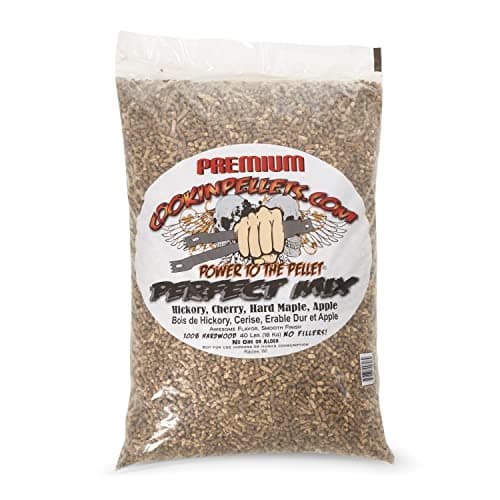
| Best Overall | CookinPellets Perfect Mix | 40 lb | Hickory, cherry, hard maple, apple — no oak/alder filler | ~$1.05 |
| Best Price Per Pound | Pit Boss Competition Blend | 40 lb | Hickory, cherry, maple, oak | ~$0.65 |
| Best Bag Under $20 | Camp Chef Competition Blend | 20 lb | Maple, hickory, cherry | ~$0.95 |
| Best for Heavy Smoke | Lumber Jack Competition Blend | 40 lb | 33.3% each maple, hickory, cherry (bark included) | ~$1.30 |
| Best Single-Species Hickory | Bear Mountain Hickory | 40 lb | 100% hickory | ~$0.90 |
| Best Fruitwood for Poultry | Kingsford Craftsmoke Applewood | 20 lb | Applewood and oak | ~$0.90 |
CookinPellets Perfect Mix (40 lb)
Pit Boss Competition Blend (40 lb)
Camp Chef Competition Blend (20 lb)
Lumber Jack Competition Blend (40 lb)
Bear Mountain Hickory (40 lb)
Kingsford Craftsmoke Applewood (20 lb)
How We Judged These Pellets
We don't run a combustion lab, and we won't pretend otherwise. This ranking is built from three things we can stand behind: what each manufacturer publishes about its own wood mix and process, verified live retail listings and bag weights checked the week this was published, and years of cooking on pellet grills plus the patterns that show up consistently in owner feedback. Where a brand won't say what's in the bag, we say that instead of guessing. Where a pellet's headline flavor is cut with oak, we say that too — including on a pick we recommend.
We also weighted cost per pound over cost per bag, because that's how pellets are actually consumed, and we gave credit for sealed, resealable packaging, which is the difference between pellets that survive a humid August and pellets that turn into auger-jamming sawdust.
1. CookinPellets Perfect Mix — Best Overall
The CookinPellets Perfect Mix is the bag we'd hand to someone who asked one question: "what should I put in the hopper?" It's a four-wood blend — hickory, cherry, hard maple, and apple — and the reason it tops this list is what CookinPellets says isn't in it. The company states the pellets contain no oak or alder filler, no bark, and no added oils or flavorings, which is a stronger claim than nearly anyone else in the category makes. Most "flavor" pellets are a cheap-wood base carrying a minority share of the named wood. This one is sold as 100% of the four woods on the label.
In practice that combination is genuinely versatile. Hickory carries the savory backbone for beef and pork, cherry adds color and a sweet edge, maple softens the whole thing, and apple keeps it from bullying poultry. It's the rare blend that suits a 16-hour brisket and a tray of chicken thighs without you swapping bags. Because it only comes in a 40-pound bag, it also lands near the middle of the pack on cost per pound despite being a premium product.
The honest catches: 40 pounds is the only size, so there's no cheap way to sample it, and it's an awkward sack to lift and store — you'll want a sealed bin. And because it's a blend, you can't dial in a single wood the way a straight hickory or straight cherry bag lets you. If you're chasing one specific smoke profile, buy a single-species bag instead.
Pros
- Four real flavor woods — hickory, cherry, hard maple, apple
- Brand states no oak or alder filler, no bark, no added oils
- Genuinely all-purpose: works on beef, pork, and poultry without a bag swap
- 40-lb bag keeps the per-pound cost reasonable for a premium pellet
Cons
- 40 lb is the only size — no small bag to try it first
- Heavy to lift and needs a sealed container for storage
- Blend only, so you can't isolate a single wood profile
If you're deciding which wood suits which meat before you commit to a 40-pound bag, our wood pellet flavor guide breaks down every profile side by side.
2. Pit Boss Competition Blend — Best Price Per Pound
At roughly $0.65 a pound, the Pit Boss Competition Blend is the cheapest legitimate pellet on this list by a wide margin — about half the per-pound cost of the premium bags. It's a hickory, cherry, maple, and oak mix in a resealable 40-pound bag, and for the cooking most people actually do — burgers, wings, pork butts, weeknight chicken — it does the job without you thinking twice about burning through it. If you run a big-capacity grill or cook most weekends, the savings across a season are real.
Here's the part worth knowing before you buy: oak is in the mix, and Pit Boss states that the actual blend composition is subject to change without notice due to seasonality, regionality, and availability. That is an unusually transparent disclosure, and we'd rather you have it than not. What it means in practice is that this is a fuel pellet with flavor, rather than a flavor pellet you can count on tasting identical bag to bag. For high-volume cooking that's a fair trade. For a single showpiece brisket, spend the extra on a bag that publishes its mix.
Pros
- Cheapest per pound here — roughly half the premium bags
- 40-lb resealable bag, widely stocked in stores and online
- Four hardwoods including hickory and cherry; fine for everyday cooks
- The value pick if you cook often or run a large grill
Cons
- Oak is part of the blend, diluting the flavor woods
- Pit Boss says the mix can change by season, region, and availability
- No published proportions — you can't know the ratio you're getting
3. Camp Chef Competition Blend — Best Bag Under $20
If you don't want to commit to 40 pounds, the Camp Chef Competition Blend is the best small bag on the shelf. It's maple, hickory, and cherry — the classic competition trio — and Camp Chef states the pellets are 100% pure virgin hardwood with no added fillers or flavors, kiln-dried to a low moisture content so they burn hot and leave less ash. At around $19 for 20 pounds it lands close to a dollar a pound, which is fair for a bag you can carry with one hand and store in a corner of the garage.
It's the pick for occasional cooks, apartment and patio owners with nowhere to put a 40-pound sack, and anyone running a portable pellet grill where a 20-pound bag is already more than a weekend needs. The blend leans mild and sweet — a good match for pork and poultry, and pleasant on almost everything.
The trade-offs are the flip side of the same coin. You pay more per pound than the 40-pound bags for the convenience of a small one, and Camp Chef doesn't publish the ratio of the three woods. And "mild and sweet" means it's not the bag to reach for when you want an assertive beef smoke — that's what the next two picks are for.
Pros
- Best small bag: about $19 for 20 lb, easy to carry and store
- Maple-hickory-cherry, the standard competition trio
- Camp Chef states 100% virgin hardwood, no fillers or flavorings
- Kiln-dried low moisture for a hot, low-ash burn
Cons
- Costs more per pound than the 40-lb bags
- Wood proportions aren't published
- Mild profile — not the pick for a bold beef smoke
4. Lumber Jack Competition Blend — Best for Heavy Smoke
The Lumber Jack Competition Blend is the most specific bag here, and the one smoke chasers keep coming back to. Lumber Jack publishes the exact recipe — 33.3% maple, 33.3% hickory, 33.3% cherry — with no oils, sprays, fillers, or binders. More unusually, the company makes its pellets from the bark and cambium layers of the tree rather than stripping them out, on the argument that those layers carry the most flavor compounds. The pellets are also milled to a smaller diameter, which increases surface area for a hotter, smokier burn.
The result is a noticeably more assertive smoke than a standard blend, which is exactly what you want on ribs, pork shoulder, and beef, and exactly why some people prefer something calmer. It's the bag to buy if your honest complaint about pellet grilling is "I wish it tasted more like a stick burner."
Two honest cons. It's the most expensive pellet on this list per pound — roughly double the Pit Boss bag — so you're paying a real premium for that published recipe. And bark cuts both ways: more flavor compounds also means more ash in the fire pot, so expect to clean more often than you would running a low-ash, bark-free pellet. If your grill already runs hot and smoky, or you mostly cook delicate foods like fish and vegetables, this can be too much of a good thing.
Pros
- Publishes the exact recipe: 33.3% each maple, hickory, cherry
- No oils, sprays, fillers, or binders
- Bark and cambium included for a heavier, more stick-burner-like smoke
- Smaller pellet diameter burns hot with a lot of surface area
Cons
- Most expensive per pound of any pick here
- Bark content means more ash and more fire-pot cleaning
- Assertive smoke can overwhelm fish, vegetables, and delicate cooks
5. Bear Mountain Hickory — Best Single-Species Hickory
Every pellet cook eventually wants a straight hickory bag, and the Bear Mountain Hickory is the one we'd buy. It's 100% hickory — not hickory-flavored — and Bear Mountain states its pellets are all-natural hardwood with no flavorings, fillers, or additives, with a low moisture content for a clean burn. At roughly $0.90 a pound in a 40-pound bag, it's also the cheapest way here to get a true single-species pellet, which is normally where prices climb.
Hickory is the default American barbecue smoke: bold, bacon-adjacent, and the traditional match for brisket, pork shoulder, and ribs. Running a single species instead of a blend is also the best way to actually learn smoke — once you know what straight hickory tastes like on a pork butt, you can decide whether you want cherry softening it next time.
The cons are inherent to the wood, not the brand. Hickory is strong, and on a very long cook — or on poultry, fish, or vegetables — it can tip from rich to acrid if you're heavy-handed. Many cooks solve that by mixing half a hopper of hickory with half a hopper of a fruitwood, which works fine. And like any 40-pound bag, it needs dry storage.
Pros
- True 100% hickory, not an oak base with hickory flavoring
- Brand states no flavorings, fillers, or additives; low moisture
- About $0.90/lb — the cheapest single-species pellet here
- The classic smoke for brisket, pork shoulder, and ribs
Cons
- Strong enough to turn harsh on long cooks if overdone
- Too assertive for poultry, fish, and vegetables on its own
- 40-lb bag needs a sealed, dry storage container
6. Kingsford Craftsmoke Applewood — Best Fruitwood for Poultry
Fruitwood is what makes smoked chicken wings, turkey, and pork sing, and the Kingsford Craftsmoke Applewood is the cheapest well-made way into it — about $18 for a 20-pound bag, roughly $0.90 a pound. Kingsford states the pellets are 100% natural hardwood with no fillers, oils, or additives, and the profile is exactly what you want on lighter proteins: mild, sweet, and clean rather than heavy.
It's also a sensible second bag to keep next to a hickory or a competition blend. Poultry and fish cook fast and take on smoke quickly, so a gentler wood keeps you from oversmoking a bird in the two hours it's on the grate.
Now the honest part, and it's the reason this pick is last rather than higher: it's an applewood and oak blend, not 100% apple. The bag says "Applewood," the wood inside is apple cut with oak, and Kingsford says so in its own product description. That's normal for the price — genuinely pure fruitwood costs considerably more — but you should know what you're buying. Craftsmoke is also a relatively new line, so there's less long-term owner feedback on bag-to-bag consistency than there is for the older brands here.
Pros
- Cheapest good fruitwood option — about $18 for 20 lb
- Mild, sweet smoke that suits chicken, turkey, pork, and fish
- Brand states 100% natural hardwood with no fillers, oils, or additives
- Small bag is easy to keep as a second flavor alongside a hickory
Cons
- Apple blended with oak — not a pure applewood pellet
- Newer line with less long-term owner feedback
- 20 lb only, so no bulk discount for high-volume cooking
What About Traeger, Weber, and the Store Brands?
Traeger® sells the most pellets in America, and its own bags are good — 100% hardwood, consistent, and stocked nearly everywhere, which counts for something when you run out mid-cook on a Sunday. The catch is arithmetic. Traeger's Signature Blend now ships in an 18-pound bag rather than the 20 pounds most rivals use, which quietly pushes its cost per pound above every 40-pound bag on this list. If you own a Traeger and want the no-thought option, it's a perfectly good buy: see our Traeger Signature Blend pick and the full Traeger pellets review for how the five flavors compare.
The broader point for Traeger owners: third-party pellets do not void your grill's warranty, and any food-grade grilling pellet runs fine in the auger. Our best pellets for Traeger guide covers that question in depth if you're nervous about switching.
Store brands from Weber, Kingsford's Chef's Blend, and the grocery-aisle bags are mostly oak-based blends in the same $0.80 to $1.00 per pound range as the value picks above. They burn fine. Just read the label, and assume that any bag which doesn't name its proportions is mostly a base wood.
Matching Wood to Meat, Quickly
- Beef and brisket: hickory or oak-heavy blends. Bold smoke stands up to 12+ hours and a heavy bark.
- Pork (ribs, shoulder): hickory-cherry or a competition blend. Sweetness plus color is the classic rib profile — our best wood pellets for ribs ranking goes deeper on which bag suits wrapped versus unwrapped racks.
- Poultry and fish: apple, cherry, or maple. These cook fast and oversmoke easily.
- Vegetables and baking: maple or apple. Enough smoke to notice, not enough to dominate.
- Mesquite: the outlier — very strong, best for short, hot cooks like steak, and easy to overdo on a long smoke.
Full detail on every profile lives in our wood pellet flavor guide, and the complete pellet grill smoking guide covers how pellet choice fits into temperature control and smoke management overall.
Storage: The Part That Actually Ruins Pellets
Pellets don't go stale so much as they drink water. They're held together by the wood's own lignin, not glue, so humidity makes them swell, soften, and crumble to sawdust — and that sawdust is the most common cause of a jammed auger and a fire pot that won't light.
Three rules cover it:
- Seal them. Move pellets out of the paper bag into an airtight bucket or a gamma-seal storage bin. A resealable bag helps, but a sealed container is what actually works.
- Get them off the concrete. Concrete floors wick moisture. A shelf or pallet is enough.
- Empty the hopper between long breaks. Pellets left in a hopper through a humid stretch or a rainstorm are the ones that jam. Test suspect pellets by snapping one: a good pellet snaps clean, a ruined one crumbles.
The Bottom Line
For most people, the CookinPellets Perfect Mix is the bag to buy — four real flavor woods, no oak filler, and enough versatility to cover everything from brisket to chicken without swapping hoppers. If you cook a lot and want the lowest running cost, the Pit Boss Competition Blend is roughly half the price per pound and honest about the fact that it's an oak-inclusive fuel blend. Short on storage? The Camp Chef Competition Blend is the best 20-pound bag on the shelf. Want more smoke than a standard pellet gives you? The Lumber Jack Competition Blend publishes its recipe and includes the bark, at a price. And the two single-purpose bags round it out: Bear Mountain Hickory for real, affordable single-species beef smoke, Kingsford Craftsmoke Applewood for the gentle fruitwood that poultry needs.
Whichever you pick, buy the biggest bag you can store dry, and check the live price before you order — pellet pricing swings more than grill pricing does. Still shopping for the grill itself? Start with our best pellet grills roundup, or fill in the rest of your setup with the best pellet grill accessories.
One last thing worth knowing: no bag of pellets can fix the fact that a pellet grill's own fire burns cleanest — and smokiest — at low temperatures. If you have already switched bags and still want more smoke, a smoke tube smolders independently of the controller and adds smoke at any temperature, including with the grill switched off.
Best Overall: CookinPellets Perfect Mix
Hickory, cherry, hard maple, and apple with no oak or alder filler — the most versatile 40-lb bag we'd put in any pellet grill. Check the current price.
Whichever bag you buy, storage decides whether it survives to be burned — see how to store wood pellets.
Explore more: How Many Pellets Does a Pellet Grill Use? | Wood Pellet Flavor Guide | Best Wood Pellets for Ribs | All Best-Of Guides