
Best Pellets for Traeger Grills: Complete Buying Guide (2026)
Choosing the right pellets for your Traeger® grill is one of the easiest ways to improve your cooking without buying new equipment or learning new techniques. The pellets you burn determine the smoke flavor in your food, the consistency of your temperatures, and even how much maintenance your grill needs. A great pellet elevates every cook. A bad pellet creates problems.
This guide covers the best pellets for Traeger® grills — both Traeger-brand and third-party options — with specific recommendations for every protein, budget, and cooking style. Whether you are loading your hopper for the first time or looking to optimize your pellet selection after years of grilling, you will find what you need here.
Best Pellets for Traeger: Our Top Picks
Here are our top pellet recommendations at a glance:
| Category | Top Pick | Why |
|---|---|---|
| Best All-Purpose | Traeger® Signature Blend | Works with everything, balanced flavor, zero guesswork |
| Best for Brisket | Traeger® Hickory | Bold, savory smoke that complements beef perfectly |
| Best for Ribs | Traeger® Cherry | Sweet, mild smoke with beautiful color on the bark |
| Best for Poultry | Traeger® Apple | Delicate smoke that enhances without overpowering |
| Best for Max Smoke | Traeger® Mesquite | The boldest smoke flavor available in pellet form |
Every pick above is a Traeger-brand pellet because this is a guide for Traeger® grill owners and Traeger® pellets are guaranteed to perform optimally in Traeger® hardware. That said, you absolutely do not have to use Traeger® pellets — we cover excellent third-party alternatives below.
Do You Have to Use Traeger Pellets?
No. This is one of the most common misconceptions in pellet grilling. Your Traeger® grill will run any food-grade hardwood pellet on the market. The grill does not know or care what brand is in the hopper. The auger, fire pot, and combustion system work identically with any properly manufactured pellet.
Traeger® recommends their own pellets, and they perform very well, but the idea that using third-party pellets will void your warranty or damage your grill is simply not true. The only pellets you should avoid in a Traeger® (or any pellet grill) are:
- Heating pellets — Made from softwood and intended for pellet stoves, not grills. They can contain binding agents and produce toxic residue.
- Pellets with fillers — Some budget brands use a base of cheap wood with flavored coating. Technically food-safe, but they produce more ash and less authentic flavor.
- Pellets with softwood content — Pine, spruce, and fir produce unpleasant resinous smoke and should never be used for cooking.
Any 100% food-grade hardwood pellet from a reputable manufacturer is safe and effective in your Traeger®. For a deeper comparison of Traeger® pellets vs alternatives, see our Traeger pellets review.
Top Pellet Recommendations by Category
Best All-Purpose: Traeger Signature Blend
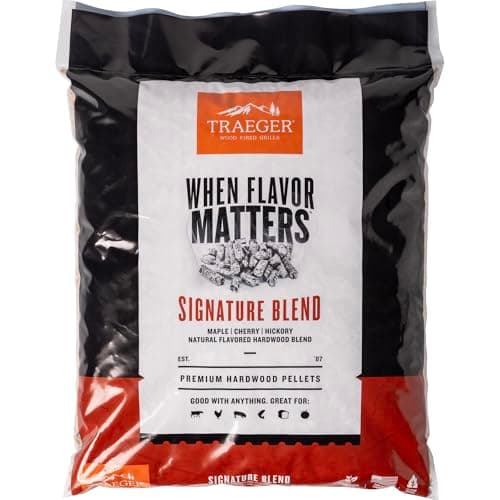
Traeger® Signature Blend PelletsIf you want one pellet that handles everything and makes choosing easy, Signature Blend is the answer. It is a balanced mix of maple, hickory, and cherry hardwoods that produces a medium-intensity smoke suitable for any protein, any temperature, and any cooking method.
Why it wins: Signature Blend eliminates decision fatigue. Load it in the hopper and cook whatever you want — chicken thighs, pork belly, pizza, burgers, brisket, vegetables. It will not deliver the boldest smoke on beef or the most delicate touch on fish, but it will be good-to-very-good on absolutely everything.
When to choose something else: When you want a specific flavor profile dialed in for a particular cook. All-purpose pellets are generalists — specialists exist for a reason.
Best for Brisket: Traeger Hickory
Traeger® Hickory PelletsHickory is the default brisket pellet and has been since the invention of pellet grilling. Its bold, savory, slightly sweet smoke profile complements the rich, beefy flavor of brisket without competing with it. The medium-strong intensity is perfect for long cooks of 10-14 hours, where lighter woods would produce an imperceptible smoke flavor.
Why it wins: Hickory produces the classic Texas-style BBQ smoke flavor that most people associate with great brisket. It is strong enough to penetrate a thick packer brisket during a long cook but clean enough to avoid bitterness within the normal 12-14 hour window.
Pro tip: For briskets running longer than 14 hours, blend 70% hickory with 30% cherry to keep the smoke profile clean through the extended cook time. See our complete best pellets for brisket ranking for detailed analysis.
Best for Ribs: Traeger Cherry
Traeger® Cherry PelletsCherry is the premier rib pellet because it delivers exactly what great ribs need: a subtle sweetness that enhances the pork flavor, a clean medium-mild smoke that does not overpower the rub and sauce, and a slightly reddish tint on the bark that makes ribs look as good as they taste.
Why it wins: The sweetness of cherry smoke pairs naturally with the sweetness commonly found in BBQ rubs and glazes. It creates a harmonious flavor profile rather than competing flavors. Cherry also works at the 5-6 hour cook time typical for ribs without any risk of bitterness.
Runner-up: A 50/50 blend of cherry and hickory is the most popular competition rib blend for good reason — you get the sweetness and color of cherry with the savory backbone of hickory.
Best for Poultry: Traeger Apple
Traeger® Apple PelletsPoultry is a delicate protein that can be overwhelmed by strong smoke. Apple pellets produce the lightest, most subtle smoke in the Traeger® lineup — just enough to give smoked chicken thighs or a whole turkey that signature outdoor-cooked flavor without tasting like a smokehouse.
Why it wins: Apple strikes the perfect balance between "smoked" and "not too smoky" for chicken and turkey. Even guests who claim they do not like smoked food will enjoy poultry cooked over apple pellets because the smoke is a supporting character, not the star.
Also great for: Fish (especially salmon), vegetables, smoked cheese, and smoked deviled eggs.
Best for Maximum Smoke: Traeger Mesquite
Traeger® Mesquite PelletsWhen you want the most aggressive smoke flavor a pellet grill can produce, mesquite is the only option. It burns hotter and produces a more intense, earthy smoke than any other hardwood. If you are grilling steaks, making fajita meat, or cooking burgers where you want bold smoke impact in 30-60 minutes, mesquite delivers.
Why it wins: No other pellet flavor comes close to mesquite's intensity. For short, high-heat cooks, it packs more smoke flavor per minute than hickory, cherry, or any blend.
Caution: Mesquite is too intense for most long cooks (over 8 hours) when used alone. Blend it 50/50 with oak or Signature Blend for longer sessions. Avoid mesquite entirely on delicate proteins like fish and chicken breast.
Wood Pellet Flavor Guide
Use this reference table to match pellet flavors to intensity levels and ideal proteins:
| Wood | Intensity | Flavor Character | Best Proteins |
|---|---|---|---|
| Apple | Mild | Light, fruity, sweet | Poultry, fish, vegetables, cheese |
| Alder | Mild | Clean, delicate, slightly woody | Salmon, trout, shellfish |
| Maple | Mild | Subtle sweetness, clean finish | Poultry, pork, ham, vegetables |
| Cherry | Medium-Mild | Sweet, fruity, adds reddish color | Pork ribs, poultry, ham, pork shoulder |
| Pecan | Medium | Rich, nutty, mellow | Pork, poultry, brisket, game |
| Signature Blend | Medium | Balanced, versatile, slightly savory | Everything |
| Oak | Medium | Neutral, clean, sturdy base | Beef, pork, excellent blending wood |
| Hickory | Medium-Strong | Bold, savory, bacony | Brisket, ribs, pork shoulder, burgers |
| Mesquite | Strong | Intense, earthy, Southwest | Steaks, burgers, fajitas, jerky |
For complete flavor profiles with detailed tasting notes and pairing guidance, our wood pellet flavor guide goes much deeper into each species.
Can You Mix Pellet Flavors?
Yes, and you should. Blending pellets is one of the best-kept secrets in pellet grilling — it lets you create custom flavor profiles that no single wood can match. Just pour multiple pellet varieties into the hopper together. The auger does a reasonable job of mixing them as it feeds.
Popular blends to try:
| Blend | Ratio | Best For |
|---|---|---|
| Hickory + Cherry | 50/50 | Ribs, pork shoulder (competition classic) |
| Hickory + Mesquite | 70/30 | Brisket (bold with complexity) |
| Apple + Cherry | 50/50 | Poultry, pork chops (sweet and fruity) |
| Mesquite + Oak | 50/50 | Steaks, burgers (bold but clean) |
| Hickory + Apple | 60/40 | Chicken thighs, pork tenderloin (savory-sweet) |
| Cherry + Pecan | 50/50 | Ham, pork belly, ribs (rich and sweet) |
Blending tips:
- Start with a 50/50 ratio and adjust based on your preference
- The stronger wood will dominate, so use less of intense woods like mesquite
- Mix pellets in a bucket before pouring into the hopper for more even blending
- Keep notes on your blends so you can replicate the ones you love
How Many Pellets Does a Traeger Use?
Pellet consumption varies by temperature, ambient conditions, and grill model. Here is a general guide:
| Cooking Temperature | Burn Rate (per hour) | 20 lb Bag Lasts |
|---|---|---|
| 180°F (Super Smoke) | 0.75-1 lb | 20-26 hours |
| 225°F (Low & Slow) | 1-1.5 lb | 13-20 hours |
| 275°F (Moderate) | 1.5-2 lb | 10-13 hours |
| 350°F (Roasting) | 2-2.5 lb | 8-10 hours |
| 450°F (High Heat) | 2.5-3 lb | 6-8 hours |
| 500°F (Max) | 3-3.5 lb | 5-7 hours |
Factors that increase consumption:
- Cold weather. Cooking at 20°F outside can increase pellet consumption by 30-50% compared to 70°F. Insulated models like the Traeger® Ironwood handle cold weather significantly better.
- Wind. Wind strips heat from the barrel, forcing the grill to burn more pellets to maintain temperature.
- Frequent lid opening. Every lid opening drops the temperature 50-100°F, requiring additional pellets to recover.
- Larger grill models. The Ironwood XL and Timberline have more internal volume to heat, consuming slightly more pellets at the same temperature than smaller models like the Woodridge™.
Cost per cook: At average consumption of 1.5 pounds per hour during a typical 4-hour cook, you use about 6 pounds of pellets. At Traeger® pricing ($1/lb), that is $6 per cook. At Lumberjack pricing ($0.65/lb), it is about $4 per cook. Pellet fuel cost is modest regardless of brand.
What to Avoid: Pellet Red Flags
Not all pellets are safe or appropriate for cooking. Watch for these warning signs:
Softwood content. Pellets made from pine, spruce, fir, or other softwoods are heating pellets designed for pellet stoves, not food. They produce acrid, resinous smoke that tastes terrible and may deposit unhealthy residue on food. Never use heating pellets in a grill.
Binding agents and fillers. Quality pellets hold their shape through the natural lignin in hardwood, released during the high-pressure manufacturing process. Some cheap brands add binding agents (vegetable oil, starch, or food-grade wax) to compensate for lower-quality wood. These additives increase ash output and can produce off-flavors.
High moisture content. Pellets should feel hard, smooth, and dry. If they feel soft, swell easily, or crumble when you squeeze them, the moisture content is too high. High-moisture pellets produce more steam than smoke, lower BTU output, and excessive ash. Always do the snap test — break a pellet in half. It should snap cleanly.
Unknown wood source. Avoid pellets that do not clearly state the wood species on the bag. Reputable brands (Traeger®, Lumberjack, Bear Mountain, CookinPellets) always disclose exactly what wood is in the product. If the label says "hardwood blend" without specifics, the manufacturer may be using whatever wood is cheapest that week.
Excessive dust in the bag. Open the bag and look at the bottom. A small amount of sawdust is normal from shipping. Excessive dust (more than a tablespoon per bag) indicates pellets that are crumbling — either from moisture exposure, poor manufacturing, or age. Dust clogs the auger and fire pot.
How to Store Wood Pellets
Proper storage protects your pellet investment and prevents the majority of pellet-related grill problems (auger jams, poor ignition, temperature swings, excessive ash).
The rules:
-
Sealed container. Transfer opened bags into an airtight container immediately. A 5-gallon bucket with a gamma seal lid is ideal — it holds 20 pounds, seals tightly, and costs under $15.
-
Dry location. Store indoors or in a climate-controlled space if possible. A garage shelf is acceptable in dry climates. In humid regions, store pellets inside the house or in a sealed container with a desiccant packet.
-
Off the ground. Never store pellet containers directly on a concrete floor. Concrete wicks moisture upward, especially in garages and basements. Place containers on a shelf, wooden pallet, or elevated platform.
-
Away from temperature extremes. Do not store pellets next to a water heater, furnace, or in direct sunlight. Temperature cycling promotes condensation inside containers.
-
Empty the hopper. If you will not be grilling for more than a week (or sooner in humid climates), empty the hopper and return pellets to a sealed container. The hopper is not airtight — moisture can enter through the exhaust vent, lid gap, and auger tube.
Quick test before every cook: Grab a pellet from the bag or hopper and snap it in half. A crisp, clean break means the pellet is dry and ready to use. A soft, crumbly break means the pellet has absorbed moisture — replace it with fresh stock.
Our Recommendation
For Traeger® grill owners who want the simplest, most reliable pellet experience, keep two bags on hand:
- Traeger® Signature Blend as your default, everyday pellet. Load it and cook anything.
- Traeger® Hickory for brisket, ribs, pork shoulder, and any time you want bold, traditional BBQ smoke flavor.
With those two bags, you can handle 90% of cooking situations. Add Cherry if you smoke a lot of pork ribs, and Apple if you smoke a lot of poultry or fish.
For budget-conscious grillers who cook frequently, quality third-party pellets like Lumberjack and Bear Mountain deliver 90-95% of the performance at 60-70% of the price. There is no shame in saving money on pellets and spending it on better meat instead. If you want the multi-brand shortlist, our roundup of the best wood pellets for smoking compares six current bags on what each brand actually discloses about its wood mix — and on cost per pound, not cost per bag.
No matter what brand you choose, stick with 100% hardwood pellets, store them dry, and replace them if they fail the snap test. Get those basics right, and your Traeger® will deliver great smoke every time.
Ready to Stock Your Hopper?
Start with Traeger Signature Blend — the all-purpose pellet that works with every protein, every temperature, and every cooking style.
Explore more: Complete Smoking Guide | Wood Pellet Flavor Guide | Best Pellets for Brisket | All Guides