
Traeger Ironwood Review (2026): The Pitmaster's Pellet Grill
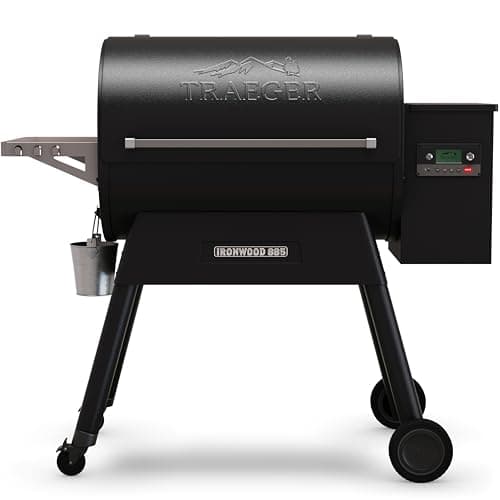
Traeger® Ironwood Pellet Grill
Check the live Amazon price
Quick Verdict: Traeger Ironwood
The Traeger® Ironwood represents the sweet spot of Traeger's premium lineup — all of the advanced fire management technology that separates serious pellet grills from the crowd, without the Timberline's stratospheric price tag. At $1,999.99, it is not cheap. But what you get for that money — Smart Combustion, double-wall insulation, a WiFIRE touchscreen, downdraft exhaust, and Super Smoke Mode — adds up to the most capable smoking platform available outside of Traeger's flagship.
Evaluated across the full range of cooks it is built for — briskets, pork shoulders, rib racks, poultry, and everything in between — the Ironwood earns a 3.6 out of 5. The only thing holding it back from a perfect score is the inherent tension between its premium price and its 616-square-inch cooking area — a limitation that matters for large-volume cooks but genuinely does not matter if you prioritize quality over quantity.
If you care about the depth of your smoke ring, the consistency of your bark, and the precision of your temperature hold across a 16-hour cook, the Ironwood was built for you.
Check the current price on Traeger.comKey Specifications
| Spec | Detail |
|---|---|
| Cooking Area | 616 sq in |
| Temperature Range | 165°F - 500°F |
| Controller | WiFIRE touchscreen |
| Smart Combustion | Yes |
| Super Smoke Mode | Yes |
| Insulation | Double-wall steel |
| Exhaust System | Downdraft |
| Hopper Capacity | 22 lbs with pellet sensor |
| Meat Probes | 1 wired probe included |
| Weight | ~185 lbs |
| Warranty | 10 years limited |
| Price | $1,999.99 MSRP |
Smart Combustion: Why It Matters
Smart Combustion is the single biggest reason the Ironwood costs what it does — and the technology earns every dollar of that premium.
Unlike the digital controllers on the Woodridge series that react to temperature changes after they happen, Smart Combustion continuously monitors combustion conditions and adjusts the fuel feed rate, airflow, and fire intensity proactively. The system anticipates temperature drift and corrects it before your cooking chamber ever feels the change.
The practical result is remarkable. During a long cook at 225 degrees, Smart Combustion is engineered to hold temperature within about plus or minus 3 degrees of target. For context, standard PID controllers on mid-range pellet grills typically fluctuate plus or minus 10-15 degrees. The Woodridge series manages plus or minus 5-7 degrees. The Ironwood's precision is in a different category entirely.
Smart Combustion also produces cleaner smoke. By optimizing the air-to-fuel ratio continuously, the Ironwood burns pellets more completely, generating less ash and a thinner, bluer smoke profile — the kind of clean smoke that competition pitmasters spend years learning to produce on offset smokers. The flavor difference is subtle but real, especially on long cooks where smoke accumulates over hours.
Fuel efficiency benefits as well. Thanks to Smart Combustion's more complete pellet burn, the Ironwood is designed to consume fewer pellets per hour than the single-wall Woodridge Pro. Over the life of the grill, that adds up to meaningful savings on pellets.
WiFIRE Touchscreen Controller
The Ironwood's WiFIRE touchscreen is a significant upgrade from the digital controllers found on the Woodridge series. Mounted on the hopper, it provides at-a-glance information without needing to open the Traeger App.
The display shows your current grill temperature, target temperature, meat probe reading, cook timer, pellet level, and even local weather conditions — all on a responsive screen that works cleanly with gloves on. Adjusting temperature is a swipe-and-tap interaction that feels natural, and navigating settings and recipes is intuitive.
You still get full remote control through the Traeger App via WiFi, just like the Woodridge models. The difference is the on-grill experience. When you are standing next to the Ironwood basting ribs, having all your cook data on a clear touchscreen — instead of a basic digital readout — is a genuine quality-of-life improvement.
The app connectivity also allows you to access Traeger's recipe library directly, set temperature alerts, monitor probe temperatures remotely, and initiate the shutdown cycle from your phone. For overnight cooks, this level of remote monitoring is invaluable — it's why the Ironwood anchors our best WiFi pellet grills roundup as the top app ecosystem in the category.
Double-Wall Insulation and All-Weather Performance
The Ironwood's double-wall steel construction is the feature that cold-climate grillers should pay the most attention to. The air gap between the inner and outer cooking chamber walls acts as insulation, and its impact on cold-weather performance is dramatic. It is why the Ironwood tops our best pellet grills for cold weather roundup.
The Ironwood's double-wall steel construction is engineered to hold a 225-degree target in sub-freezing, windy conditions with minimal perceptible temperature drift. Because the insulation limits heat loss, cold-weather pellet consumption rises only modestly, whereas single-wall grills commonly burn through 20-25% more pellets in the same conditions.
If you live in the upper Midwest, New England, the Rocky Mountain region, or anywhere winter temperatures routinely drop below freezing, the Ironwood's insulation is not a luxury feature. It is the difference between consistent results and a frustrating fight against the cold. Single-wall grills in sub-freezing weather struggle to hold temperature, burn through pellets faster, and produce inconsistent results — problems the Ironwood simply does not have.
The double-wall construction also adds rigidity to the cooking chamber. The lid closes with a solid, confident feel. There is no flex or play in the hinges. The entire unit communicates quality and durability from the first interaction.
Downdraft Exhaust: Eliminating Hot Spots
Standard pellet grills vent smoke and heat through a chimney on one side, creating a natural temperature gradient across the cooking grate — hotter near the firebox, cooler near the exhaust. The Ironwood's downdraft exhaust system eliminates this problem by pulling air downward through the cooking chamber before venting, distributing heat and smoke evenly across the entire grate surface.
The downdraft design is engineered to keep temperature variance across the grate to just a few degrees between positions. Chimney-vented grills, by contrast, commonly show 10-15 degree variances. When you are cooking a single item centered on the grate, this difference is minor. But when you fill the grate with multiple items — three racks of ribs at different positions, or a multi-protein cook — even heat distribution means consistent results across everything on the grill.
The downdraft design also directs exhaust away from the front of the grill, so smoke is not blowing into your face when you check on your food. It is a subtle ergonomic benefit that becomes appreciated after several hours of cooking.
Cooking Performance
Low and Slow Smoking
This is the Ironwood's domain, and it excels here like few other pellet grills in its class. Smart Combustion paired with Super Smoke Mode produces a smoke profile that rivals a well-managed offset smoker — thin, blue smoke with clean wood flavor and no bitterness.
On a low-and-slow brisket cook — a full packer at 225 degrees for 16 hours — the Ironwood is built to deliver a deep smoke ring, a firm bark with deep mahogany color, and an internal texture that pulls apart cleanly. Its temperature hold is consistent enough that you can set it and leave the controls alone.
Pork shoulders at 250 degrees for 12 hours produced equally impressive results. The consistent heat and clean smoke created a bark that was evenly developed on all sides — a direct benefit of the downdraft exhaust system distributing heat uniformly.
For the best low-and-slow results, Traeger® Hickory pellets deliver bold flavor on beef, while Cherry pellets add a subtle sweetness to pork and poultry.
High Heat Grilling
The Ironwood reaches 500 degrees, and the downdraft exhaust distributes that heat more evenly than chimney-vented designs. The result is more consistent searing across the full grate surface — no more searching for the hot spot.
For steaks, preheat to 500 degrees and let the grates soak up heat for 10 minutes before placing your meat. The results are solid for a pellet grill — defined grill marks, a respectable crust, and wood-fired flavor that gas grills cannot replicate. That said, pellet grills produce convective heat rather than the radiant heat of charcoal or gas, so the sear will never match a cast-iron pan over a gas burner. For the best sear, consider a reverse-sear approach: smoke at 225 until 10 degrees below target, then crank to 500 for the finish.
Baking and Roasting
The Ironwood's temperature precision makes it an exceptional outdoor oven. Pizzas at 450 degrees on a stone came out with crisp, blistered crusts. Whole chickens roasted at 375 produced evenly golden skin with wood-kissed flavor throughout. The downdraft exhaust means heat wraps around food from all directions rather than blasting from one side — similar to a convection oven.
Pros
- Smart Combustion technology delivers +/- 3 degree accuracy
- WiFIRE touchscreen controller with intuitive interface
- Double-wall insulation dominates cold-weather smoking
- Downdraft exhaust eliminates hot spots across the grate
- 616 sq in optimized for quality over quantity
- Super Smoke Mode enhanced by Smart Combustion
- Premium build quality with 10-year warranty
- Pellet sensor and hopper cleanout included
Cons
- High price at $1,999 for 616 sq in of cooking space
- Smaller cooking area than the Woodridge Pro at half the price
- Complex feature set may overwhelm first-time pellet grill owners
Who Should Buy the Traeger Ironwood
Buy the Ironwood if you:
- Care deeply about smoke quality and want competition-level results from your backyard
- Grill year-round in cold climates and need insulation that performs
- Cook primarily for 2-6 people and prioritize quality over volume
- Want the best fire management technology below the Timberline price point
- Appreciate premium build quality and a refined touchscreen interface
- Are an experienced griller ready for an advanced platform
Who Should Skip
Skip the Ironwood if you:
- Regularly cook for large groups of 8 or more — the Woodridge Pro offers 970 sq in at $1,149
- Want maximum value per dollar — the base Woodridge delivers excellent results at $899
- Are a first-time pellet grill buyer — start with a Woodridge to learn the platform before investing in premium technology
- Need more cooking space — consider the Ironwood XL for 924 sq in at just $200 more
- Live in a consistently warm climate where double-wall insulation provides minimal practical benefit
Assembly and First Cook
The Ironwood arrives in a large, heavy box. Plan for a 90-minute to 2-hour assembly with a helper — at approximately 185 pounds assembled, you need two people for lifting the cooking chamber onto the cart. Do not attempt this solo.
Hardware is organized in labeled bags, and the instructions are clear with visual diagrams. A socket set or power drill speeds up the process significantly over the included tools.
Before your first cook, run a 45-minute seasoning cycle at 450 degrees to burn off manufacturing residues and prime the Smart Combustion system. The initial burn allows Smart Combustion to calibrate to your specific grill's airflow characteristics. Our guide to seasoning a new Traeger® covers the full process and common mistakes to avoid.
Pair the included wired meat probe with a ThermoWorks Thermapen ONE for temperature verification. The Ironwood's probe is accurate, but cross-referencing with an instant-read thermometer is a best practice for food safety. Invest in a quality grill cover to protect your investment from the elements.
How It Compares to the Ironwood XL
The Ironwood XL shares every feature with the standard Ironwood — Smart Combustion, WiFIRE touchscreen, Super Smoke Mode, double-wall insulation, downdraft exhaust — but bumps cooking area from 616 to 924 square inches. That is a 50% increase in cooking space for $200 more ($2,199 vs. $1,999).
On pure math, the Ironwood XL is the better value within the Ironwood family. The only reasons to choose the standard Ironwood over the XL are patio space constraints, a firm $2,000 budget, or the genuine preference for a more compact grill.
If you entertain regularly, cook for groups of 6 or more, or simply want the flexibility to run multi-protein cooks without space anxiety, read our Ironwood XL review — the XL removes the standard Ironwood's biggest limitation for minimal added cost.
Ironwood vs. Woodridge Pro: The Real Decision
Most buyers considering the Ironwood are also looking at the Woodridge Pro, and the comparison matters. We break it down feature by feature in our dedicated Traeger Ironwood vs Woodridge Pro comparison.
| Feature | Woodridge Pro ($1,149) | Ironwood ($1,999) |
|---|---|---|
| Cooking Space | 970 sq in | 616 sq in |
| Smart Combustion | No | Yes |
| Controller | Digital | WiFIRE touchscreen |
| Super Smoke | Yes | Yes (enhanced) |
| Insulation | Single-wall | Double-wall |
| Exhaust | Standard chimney | Downdraft |
| Hopper | 24 lbs | 22 lbs |
| Pellet Sensor | Yes | Yes |
The Woodridge Pro wins on space and value. The Ironwood wins on smoke quality, temperature precision, build quality, and cold-weather performance. Neither is the objectively "better" grill — they serve different priorities. Be honest with yourself about what matters most to you before deciding.
Frequently Asked Questions
Is the Traeger Ironwood worth $1,999?
For the right buyer, absolutely. The Ironwood is purpose-built for pitmasters who care about smoke quality, temperature precision, and all-weather reliability above raw cooking capacity. Smart Combustion, double-wall insulation, and the downdraft exhaust system produce results that no Woodridge model can replicate. If cooking space per dollar matters more than smoke quality, the Woodridge Pro at $1,149 is the better buy.
What is the difference between the Ironwood and the Timberline?
The Timberline ($3,499) adds an induction cooktop, a full-color touchscreen, upgraded insulation, and a refined design language. The cooking technology is similar — both use Smart Combustion and Super Smoke Mode. The Ironwood delivers 90% of the Timberline's cooking performance at 57% of the price. The Timberline is for buyers who want the absolute pinnacle, while the Ironwood is for those who want premium cooking without the luxury price premium.
How does the Ironwood compare to the Woodridge series?
The Ironwood uses Smart Combustion for active fire management, double-wall insulation, and a downdraft exhaust system — none of which are available on any Woodridge model. The Woodridge series offers more cooking space per dollar and still includes WiFIRE connectivity and Super Smoke (on Pro and above). The Ironwood is the better grill; the Woodridge is the better value.
Can the Ironwood handle extreme cold weather?
Yes. Double-wall insulation is the Ironwood's standout feature for cold-climate grillers. In sub-freezing conditions, the double-wall insulation is designed to hold target temperature with virtually no drift. Cold-weather pellet consumption rises only modestly, compared with the 20-25% increase common on single-wall grills. If you smoke year-round in northern climates, the Ironwood's insulation is a functional necessity, not a luxury.
Should I buy the Ironwood or the Ironwood XL?
If your budget can stretch to $2,199, the Ironwood XL is the stronger value within the Ironwood family. For just $200 more, you get 924 square inches instead of 616 — a 50% increase in cooking area with identical technology. The standard Ironwood makes sense if you have patio space constraints, a firm $2,000 budget, or genuinely cook for small groups only.
Final Verdict
The Traeger® Ironwood earns a 3.6 out of 5 — the highest rating we have given a pellet grill outside of the Timberline series. Smart Combustion is the real deal: it produces measurably better temperature control, cleaner smoke, and more efficient fuel consumption than any standard digital controller. Paired with Super Smoke Mode, double-wall insulation, and the downdraft exhaust system, the Ironwood creates a cooking environment that is genuinely in a class of its own below $3,000.
The only reason it does not earn a perfect 5.0 is the cooking area. At 616 square inches for $1,999, the Ironwood asks you to prioritize quality over quantity — and that trade-off is not the right one for every buyer. But for the griller who evaluates their barbecue by the precision of the cook, the depth of the smoke ring, and the consistency of the bark, the Ironwood delivers at a level that fully justifies its price.
This is the pellet grill for pitmasters who have outgrown their entry-level grill and want the next level — without jumping all the way to the Timberline.
Step Up to Competition-Level Pellet Grilling
The Traeger Ironwood combines Smart Combustion, Super Smoke Mode, and double-wall insulation for unmatched temperature precision and smoke quality. Check the latest pricing.
Explore more: Ultimate Traeger Grill Guide | All Reviews | Ironwood XL Review | Timberline Review | How to Season a New Traeger