
Weber Searwood 600 vs Traeger Woodridge: Sear Heat or Cooking Space?
The Bottom Line
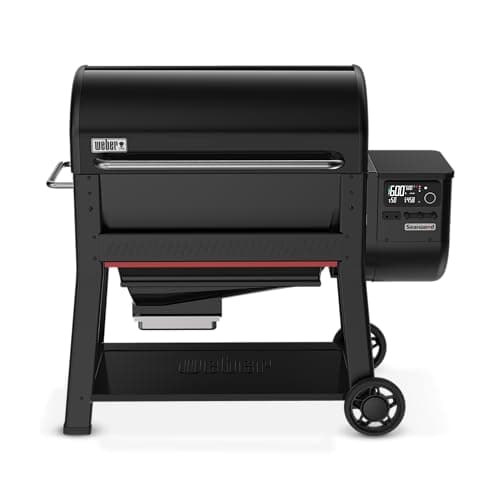
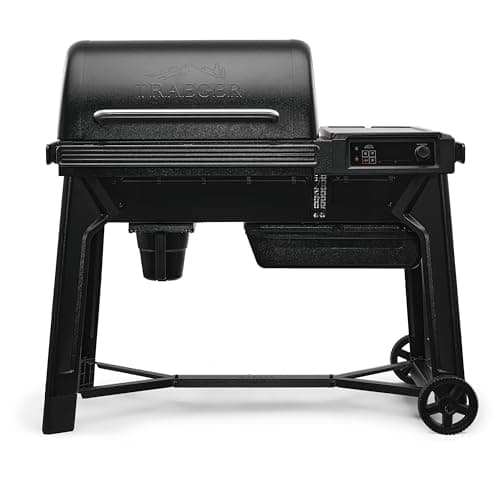
Buy the Weber Searwood 600 if it will be your only grill; buy the Traeger® Woodridge™ if you need the space and the ecosystem. These two land within roughly $100 of each other and they are the two grills most first-time four-figure pellet buyers end up holding against each other — but they were designed to win on opposite metrics.
Weber spent the budget on heat and control: a verified 600°F with direct flame across the entire grate, a Rapid React PID that held within about ±5°F in independent testing, two food probes, and a cast-aluminum cookbox. Traeger spent it on scale and coverage: 860 square inches to Weber's 648, a 24-pound hopper, WiFIRE, the EZ-Clean grease and ash keg, and a 10-year warranty that nothing else in this bracket matches.
Neither choice is wrong. The question is whether you are buying a searing grill or a smoking platform.
Live Prices
| Grill | Best for | Key specs | Price |
|---|---|---|---|
| Weber Searwood 600 | Best for the buyer who wants one grill that smokes low and sears hard | 648 sq in (420 main + 228 rack) · 180-600°F · DirectFlame full-grate sear · 20-lb hopper · 2 probes · 5-yr cookbox / 3-yr electronics | $999.00 · View on Amazon Price as of October 15, 2026 |
| Traeger Woodridge | Best for the buyer who wants the most grate, the longest warranty and WiFIRE | 860 sq in · 500°F max · 24-lb hopper · 1 wired probe · EZ-Clean keg · P.A.L. rails · 10-yr limited | $899.99 · View on Amazon Price as of October 15, 2026 |
#ad — the price buttons are affiliate links and we may earn a commission at no extra cost to you. Prices come from Amazon as of October 15, 2026; the live Amazon price always wins. See our affiliate disclosure.
Side-by-Side Specifications
| Feature | Weber Searwood 600 | Traeger Woodridge |
|---|---|---|
| Rating | 4.6 | 4.5 |
| Price | $999.00 · View on Amazon Price as of October 15, 2026 | $899.99 · View on Amazon Price as of October 15, 2026 |
| Cooking area | 648 sq in (420 main + 228 rack) | 860 sq in |
| Temperature range | 180-600°F | Up to 500°F |
| Searing | DirectFlame across the full grate; verified 600°F | No direct flame; 500°F through a diffuser |
| Smoke mode | SmokeBoost at 180°F | None (Super Smoke starts at the Woodridge Pro) |
| Hopper | 20 lb, side-mounted | 24 lb |
| Controller | Rapid React PID, held about ±5°F in testing | Digital set-and-forget controller |
| Connectivity | WiFi + Bluetooth, Weber Connect (no remote start) | WiFIRE app control |
| Probes included | 2 included | 1 wired probe |
| Cleanup system | Pull-and-Clean front drawer (grease + ash) | EZ-Clean Grease & Ash Keg (single container) |
| Build | Cast-aluminum cookbox, porcelain-enameled lid, 125.4 lb | Steel body with P.A.L. Pop-And-Lock rails |
| Warranty | 5-year cookbox / 3-year electronics | 10-year limited |
| Model / larger size | 1500120 (XL 600: 1500121) | Woodridge (Pro: 970 sq in) |
#ad — the price buttons are affiliate links and we may earn a commission at no extra cost to you. Prices come from Amazon at the time stamped on each button; the live Amazon price always wins. See our affiliate disclosure.
Why These Two Get Cross-Shopped
Both grills are their maker's answer to the same shopper: someone who has decided a pellet grill is the plan, has roughly $1,000 to spend, and wants a real brand behind it.
Weber arrived at that price from above. The Searwood (2024) is the ground-up replacement for the discontinued SmokeFire, built specifically to kill the complaint that has followed pellet grills since the beginning — that they cannot sear. It fixed the SmokeFire's hopper placement, its pellet-brand fussiness and its cleanup, and it earned AmazingRibs' Platinum Medal in the process. At $999 for the 24-inch model, Weber is selling cooking performance.
Traeger arrived from the other direction. The Woodridge (2026) is the entry point to a completely redesigned lineup, and Traeger priced it at $899.99 with more grate area than anything Weber sells in pellet form under $1,300. It is the grill that made the 10-year warranty normal at this price. Traeger is selling scale, ecosystem and confidence.
So the overlap is the price, and almost nothing else.
Head-to-Head: Searing and Top-End Heat
Weber wins, decisively, and this is the most consequential section on the page.
The Searwood runs a genuine 180-600°F. The "600" in the name is the temperature, not a size. Weber's DirectFlame system sits stainless Flavorizer bars over an open firepot, so direct heat reaches the whole cooking grate rather than a small zone over the fire, and AmazingRibs' testing confirmed a true 600°F across that entire surface. Smoked BBQ Source measured the grill reaching 600°F in 13 minutes. There is also a Manual Mode for open-lid, griddle-style cooking, which is exactly the thing a pellet controller normally fights you on.
The Woodridge tops out at 500°F through a solid diffuser. That is enough for respectable grill marks, pizza and general high-heat grilling — it is not a hard sear, and Traeger does not claim otherwise. If you want crust on the Traeger you add cast-iron grate panels or finish in a skillet, which is a real and common workaround but still a workaround.
If a steakhouse crust is on your list and you do not already own a gas grill or kettle to do that job, this single difference should decide the purchase. Our best pellet grill for searing roundup exists largely because of how rare the Searwood's capability still is.
Head-to-Head: Cooking Space
Traeger wins, by about a third.
Traeger publishes 860 square inches for the Woodridge. Weber publishes 648 for the Searwood 600 — a 420 sq in main grate (24 inches by 17.5) plus a 228 sq in upper rack. That is roughly 212 extra square inches on the Traeger for about $100 less money, which is the whole value argument for the Woodridge in one line.
In practical terms: the Searwood 600 comfortably handles a brisket, a couple of pork butts or four racks of ribs; the Woodridge handles a holiday spread without shifts. If you cook for six or fewer, the Searwood is not going to feel small. If you host, the gap is real, and our pellet grill sizing guide works through it by headcount and cut.
Both lines scale if neither size fits: the Searwood XL 600 reaches 972 square inches (and is the only one of the two Webers with a pellet fuel gauge), and the Woodridge Pro reaches 970 while adding Super Smoke, a pellet sensor and a side shelf. Those two are the closest thing to an apples-to-apples rematch, and both appear in our best pellet grills under $1,500 roundup.
Head-to-Head: Temperature Control
Weber wins on evidence.
The Searwood's Rapid React PID held within about ±5°F of setpoint in Smoked BBQ Source's testing, and their WiFi connection worked throughout. AmazingRibs noted actual grate temperatures ran about 15°F below the dial setting — worth knowing, easy to compensate for, and the kind of detail that only shows up in real measurement.
The Woodridge's digital controller has no comparable published independent test record. What exists is a consistent pattern of owner reports describing steady temperatures across long cooks and good consistency in cold weather, which is meaningful but weaker evidence than a measured number. We are not going to even that out: Weber has the stronger case here, and we would rather say so than pretend the two are equally documented.
One honest mark against the Searwood: both AmazingRibs and Smoked BBQ Source found hot and cold zones, with the right side running hotter and roughly a 50°F front-to-back difference. Plan to rotate meat on long cooks. Perfect even heat is not what either grill delivers.
Head-to-Head: App, Probes and Fuel
Split decision, with one clear hardware win for Weber.
Traeger's WiFIRE is the deeper ecosystem — remote temperature changes, a large recipe library, cook history, firmware updates — and for many buyers that ecosystem is the reason to buy Traeger. Weber Connect is simpler, works reliably, and includes a step-by-step grilling assistant that genuinely helps a first-timer. One quirk worth knowing: the Searwood has no remote start, so you light it at the grill.
On hardware, Weber wins: two food probes in the box against Traeger's one wired probe. If you want to track a brisket and a pork butt simultaneously on the Woodridge, you are buying a wireless meat thermometer on day one — budget for it.
On fuel, Traeger wins: a 24-pound hopper against Weber's 20, which at roughly 1 to 2 pounds of pellets per hour at 225°F is a meaningful cushion on an overnight cook. Neither grill at this price has a pellet-level sensor — Weber puts its fuel gauge on the XL, Traeger puts its sensor on the Pro — so both want a visual check every few hours on a long cook.
Head-to-Head: Cleanup, Build and Warranty
Traeger wins the warranty; Weber wins the object; both have a gap.
The Woodridge's 10-year limited warranty is the single most aggressive number in this comparison, and it is three times what Traeger offered at this price a generation ago. Weber covers the cookbox for 5 years and electronics for 3. For a grill you intend to keep a decade, that is a real difference.
Weber counters with construction: a cast-aluminum weatherproof cookbox with a porcelain-enameled lid, built on the same durability philosophy as Weber's gas grills. It also weighs 125.4 pounds and, as AmazingRibs pointed out, has no casters — repositioning it is awkward. Traeger's Woodridge, meanwhile, has no locking casters either, and it ships without a side shelf; the P.A.L. Pop-And-Lock rails let you add one later, which keeps the entry price down but means prep space costs extra.
Cleanup goes to a draw with different approaches. Weber's Pull-and-Clean front drawer catches grease and ash together and empties in seconds. Traeger's EZ-Clean Grease & Ash Keg consolidates both into one removable keg and is the best cleanup system Traeger has shipped. Both are a genuine improvement over the bucket-and-shop-vac era.
Shelves are the common complaint on the Weber: side and front tables are sold separately, and it is the most frequent gripe reviewers raise. Budget for one on either grill.
Who Should Buy the Weber Searwood 600
- This will be your only grill, and it has to sear as well as it smokes.
- You want published, named independent testing behind the temperature claims.
- You cook two cuts at once and want both probes in the box.
- You want the heavier, more weatherproof object and Weber's build reputation.
- 648 square inches covers your biggest normal cook.
- You already know you will buy a side table and are fine with that.
Who Should Buy the Traeger Woodridge
- You need the space — 860 square inches for about $100 less is the better value per square inch, full stop.
- You want the 10-year warranty and plan to keep the grill a decade.
- You want WiFIRE, the recipe library and the ecosystem your friends already use.
- You already own something that sears, so 500°F is plenty.
- Longer overnight cooks are normal and the 24-pound hopper matters.
- You expect to stay in the Traeger range and move up to a Woodridge Pro or Ironwood later.
How We Compared These
This comparison is built from each manufacturer's published specifications, the independent testing we can cite by name (AmazingRibs' Platinum Medal evaluation and Smoked BBQ Source's measured results on the Searwood), the owner-review patterns we track for each model, and our own full reviews of both grills. Prices come from our tracked price registry and render live on the buttons rather than being typed into the page, because grills in this bracket move on promotion.
We have not run these two side by side in a lab and we do not claim to have. Where the published evidence for one grill is stronger than for the other — and on temperature control it clearly is — we say so rather than splitting the difference.
Frequently Asked Questions
Weber Searwood 600 or Traeger Woodridge — which should I buy?
The Searwood 600 if it will be your only grill: a verified 600°F full-grate sear, about ±5°F control in testing, two probes. The Woodridge if you want space and coverage: 860 sq in, a 24-lb hopper, WiFIRE and a 10-year warranty, for about $100 less.
Which one actually sears?
The Searwood, and it is not close. DirectFlame puts real flame under the whole grate and AmazingRibs measured a true 600°F across it. The Woodridge's 500°F through a diffuser gives you grill marks, not a steakhouse crust.
Which has more cooking space?
The Woodridge: 860 square inches against 648. About 33 percent more grate for less money. Need more? The Searwood XL 600 is 972 sq in and the Woodridge Pro is 970.
Which warranty is better?
Traeger's 10-year limited coverage beats Weber's 5-year cookbox and 3-year electronics terms. Our pellet grill warranty comparison puts both against every other brand we track.
How many meat probes do they include?
Two on the Searwood, one on the Woodridge. Neither has a pellet-level sensor at this price — that is a Searwood XL and Woodridge Pro feature.
Do either of these have a dedicated smoke mode?
The Searwood has SmokeBoost at 180°F. The base Woodridge has none; Super Smoke starts at the Woodridge Pro.
Our Recommendation
The Weber Searwood 600 is the better grill, and if you are judging these two on how well they cook, the case is straightforward: it does everything the Woodridge does and then sears like a gas grill, with measured temperature control and two probes in the box. For a buyer replacing one grill with one grill, that versatility is worth the extra $100 and the smaller grate.
The Traeger Woodridge wins on the two numbers a lot of buyers care about most — square inches and warranty years — and it wins them by margins that are not close either. If you host, if the grate is your constraint, or if a decade of coverage is what lets you spend $900 without flinching, buy the Traeger and put a cast-iron panel on your accessory list.
Our Pick: Weber Searwood 600
A verified 600°F DirectFlame sear across the whole grate, Rapid React PID control, SmokeBoost at 180°F and two food probes included.
#ad — the button above is an affiliate link and we may earn a commission at no extra cost to you. See our affiliate disclosure.
Explore more: Weber Searwood 600 Review | Traeger Woodridge Review | Best Pellet Grills Under $1,500 | Traeger vs Weber | Best Pellet Grill Under $1,000 | How to Choose a Pellet Grill | Current Deals