
Traeger Drip Tray Liners: The Complete Fitment and Buying Guide (2026)
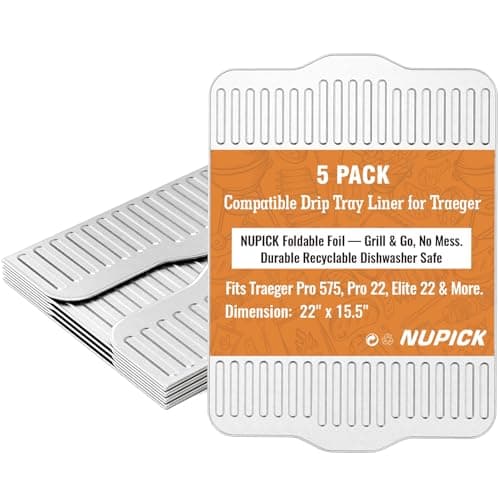
Drip tray liners are the least glamorous thing Traeger® sells and one of the few accessories that is genuinely about safety rather than convenience. The drip tray sits under the grates, collects everything that renders out of your food, and funnels it down the grease chute into a bucket or keg. When the tray itself is coated in weeks of baked-on grease, you have a tray of fuel sitting directly above the fire pot — and grease is what turns a pellet grill flare-up into a grill fire.
A liner means you lift out a tray of grease and throw it away instead of scraping one. That is the entire value proposition, and it is a real one.
The problem is that buying them is confusing. Traeger uses part numbers rather than model names, the part numbers do not follow an obvious pattern, the trays changed size across generations, and the newest grills replaced the drip bucket with a grease and ash keg that takes a completely different liner. This guide sorts that out: find your grill in the fitment table, buy a pack that lists its part number, done.
Every pack named below was verified live and in stock on October 8, 2026 through the Amazon Creators API, and every dimension quoted comes from what the manufacturer or seller publishes on the listing. We deliberately keep prices out of the prose — pack counts and pricing in this category move constantly, and a number written today is wrong next month. Each button shows the live price with the date it was read.
First: Which Part Do You Actually Need?
There are two different consumables with similar names, and buying the wrong one is the most common mistake here.
A drip tray liner is a shallow stamped aluminum tray that sits inside the cook chamber, under the grates, on top of the grill's own drip tray. It catches rendered fat before it reaches the metal. This is the BAC507 / BAC521 / BAC515 / BAC522 / BAC818 / BAC408 family, and which one you need is purely a question of your grill's tray dimensions.
A grease and ash keg liner is a small cup-shaped liner for the removable keg underneath the newer EZ-Clean grills — Woodridge™, Woodridge Pro, the current Ironwood and Timberline, and the Flatrock. These grills funnel grease and ash together into a keg you pull out and empty, and the liner means you empty a bag instead of scrubbing a keg. This is Traeger's BAC608 size.
Older grills have a drip bucket hanging off the side and a tray liner inside. The newest grills have a keg. The Woodridge sits in between — it has both a drip tray that takes a BAC818-size liner and a keg underneath that takes keg liners — so Woodridge owners should look at both sections below.
Find Your Grill
| Your Traeger® | Liner part number | Tray size | Pack that fits it |
|---|---|---|---|
| Pro 575 / Pro 22 / Elite 22 | BAC507 | 22 x 15.5 in | NUPICK BAC507, 5-pack |
| Pro 575 / Pro 22 / Elite 22, bulk | BAC507 | 22 x 15.5 in | GORGERILA BAC507, 15-pack |
| Pro 780 and Pro 575 in one pack | BAC521 + BAC507 | both sizes | SUNOHE two-size 5-pack |
| Pro 780 / Ironwood 885 | BAC521 | 28.75 x 15.5 in | BAC521 5-pack |
| Timberline 1300 | BAC515 | Timberline 1300 tray | BAC515 5-pack |
| Timberline 850 | BAC522 | Timberline 850 tray | BAC522 5-pack |
| Pro 34 / Woodridge™ | BAC818 | Pro 34 / Woodridge tray | NUPICK BAC818 liners |
| Tailgater 20 / 20 Series | BAC408 | 20-series tray | BAC408 15-pack |
| Timberline / Ironwood / Woodridge / Flatrock keg | BAC608 | grease & ash keg | Matchwaves keg liners, 25-pack |
| Woodridge™ / Woodridge Pro keg | BAC608 size | grease & ash keg | Woodridge keg liners |
If your grill is not on that list, measure the drip tray before you buy anything. Length and width at the widest point is all you need, and it beats guessing from a model year.
What Separates a Good Liner From a Bad One
For a disposable aluminum tray there is less to say than marketing suggests, but three things are real.
Dimensions, obviously — and they must match the tray, not the grill. Traeger reused tray sizes across models and changed them between generations, which is why the part number is more reliable than the model name. A liner an inch too short leaves a strip of bare tray that collects grease anyway; a liner an inch too long buckles and channels grease over the edge, which is worse than no liner at all.
Foil thickness. This is the one quality variable that matters and the one listings are vaguest about. A liner has to survive being lifted out while holding a quarter inch of hot liquid fat. Thin stamped foil tears at the corner when you do that, and then you are cleaning a drip tray and the grill floor. Owner photos and reviews are the only practical way to judge this before buying; reports of tearing on removal are the signal to avoid a pack.
Pack count versus cost per liner. The larger packs are consistently cheaper per liner than the 5-packs — on the BAC507 listings above, the 15-pack works out meaningfully lower per liner than the 5-pack did at the time of writing. If you cook weekly, buy the bigger pack. If you cook a few times a season, the 5-pack is fine and will not sit in a garage for three years.
What does not matter: the brand name on the sleeve, "heat resistant" claims (all aluminum foil is), and any claim about improving flavor or smoke. This is a tray that catches fat.
The Picks
Pro 575 / Pro 22 / Elite 22 — BAC507
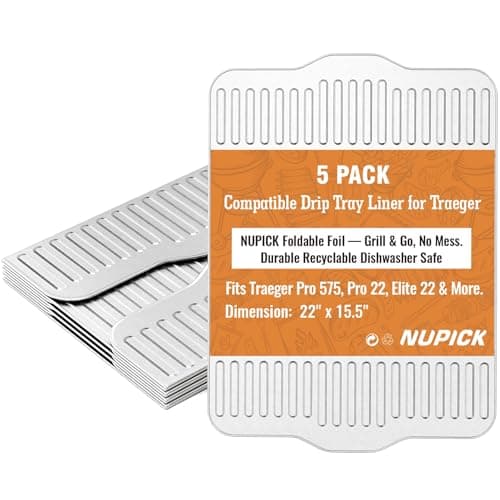
The BAC507 size — 22 x 15.5 inches — is the most common Traeger tray in circulation, because the Pro 575, Pro 22 and Elite 22 together account for an enormous number of grills still in backyards. The NUPICK BAC507 5-pack is the straightforward buy: correct dimensions, named against the Traeger part number, and in stock.
If you cook most weekends, go straight to the GORGERILA 15-pack instead. Same size, same fit, and a lower cost per liner — the only reason not to is if you would rather not store fifteen of them.
Pros
- Correct 22 x 15.5 in BAC507 dimensions, named against the Traeger part number
- Fits the three most common older Traeger models
- A 15-pack version of the same size is available when you want a lower cost per liner
- Lifts out in one piece instead of scraping the tray
Cons
- Third-party pack, so quality control varies between production batches
- 5-pack is the highest cost per liner of the BAC507 options
- Does not fit the Pro 780 — that tray is nearly 7 inches longer
- Single-use only; washing creases and weakens them
Pro 780 and Pro 575 in one pack — the two-size option
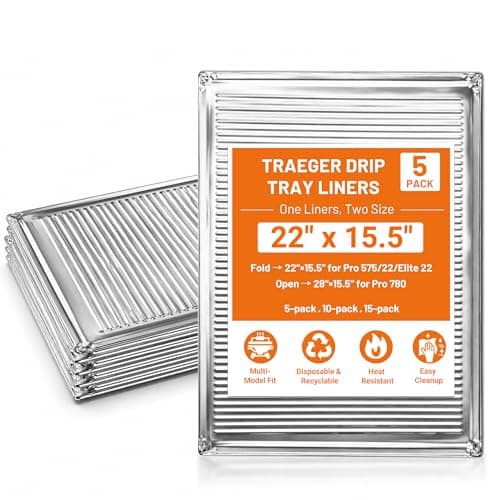
If you own two Traegers, or you are not certain which tray size yours has, the SUNOHE 5-pack in two sizes is the pragmatic answer. It ships liners in both the 22-inch and the 28 x 15.5-inch footprints, covering the Pro 780 alongside the Pro 575, Pro 22 and Elite 22.
It is the cheapest entry point of any pack here, and that is both the appeal and the caveat: you get fewer of each size than a dedicated pack gives you of one, so it is best thought of as a starter pack or a two-grill household pack rather than a season's supply.
Pros
- Covers both the 22 in and 28 x 15.5 in tray sizes in one order
- Good answer when you own two Traegers or are unsure of your tray size
- Lowest-priced pack of the drip-tray options here
- Removes the risk of ordering the wrong single size
Cons
- Fewer liners of each size than a dedicated single-size pack
- Not a season's supply if you cook weekly
- Mixed-size packs mean checking which one you are holding each time
- Does not cover the Timberline, Woodridge or 20-series sizes
Pro 780 / Ironwood 885 — BAC521
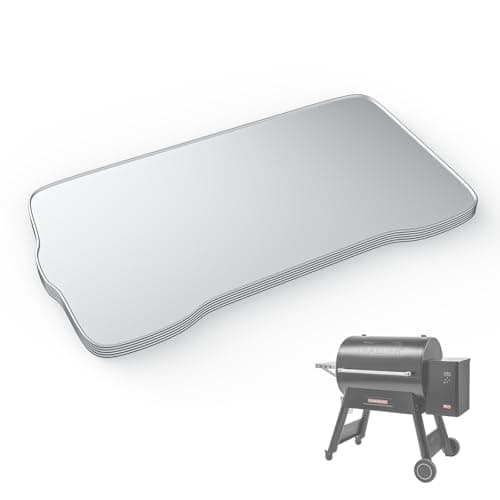
The BAC521 is the long tray — 28.75 x 15.5 inches — used by the Pro 780 and the Ironwood 885. This is the size people most often order wrong, because the Pro 780 and Pro 575 look like the same grill in two widths and the liners are not interchangeable. The BAC521 5-pack states both the part number and the measurement on the listing, which is exactly what you want when the risk is a 7-inch mismatch.
It is the priciest of the 5-packs here, which is simply a function of surface area — it is a much larger piece of stamped aluminum than a BAC507.
Pros
- Correct 28.75 x 15.5 in BAC521 dimensions for the Pro 780 and Ironwood 885
- Listing states both the part number and the measurement
- Covers the size most often ordered wrong
- Large tray means fewer changes per cook than a smaller liner would need
Cons
- Most expensive 5-pack of the drip-tray liners here
- Only sold in a 5-pack, so no bulk discount option
- Does not fit the current-generation Ironwood, which uses a grease keg
- The larger panel is more awkward to lift out full without flexing
Timberline 1300 — BAC515, and Timberline 850 — BAC522
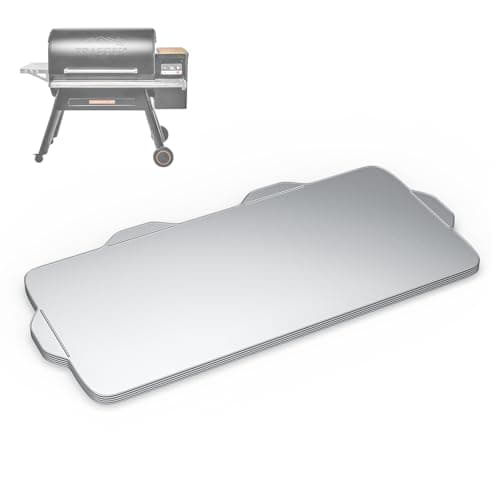
The two older Timberline sizes take different liners and it is worth being careful: the BAC515 5-pack is for the Timberline 1300, and the BAC522 5-pack is for the Timberline 850. Both are in stock, both are 5-packs, and both are named against their Traeger part number on the listing.
If you own the current Timberline — the touchscreen model with the EZ-Clean grease and ash keg — neither of these is what you want. Go to the keg liner section below.
Pros
- Correct part-number-matched liners for both older Timberline sizes
- Both sizes currently in stock, which is not always true of Timberline parts
- Saves scrubbing a large stainless drip tray on an expensive grill
- Cheaper per liner than the BAC521 pack despite similar tray geometry
Cons
- Two visually similar part numbers that are easy to confuse — check 850 vs 1300
- Neither fits the current-generation Timberline, which uses a grease keg instead
- 5-pack only for both sizes
- Older-model consumables can go out of stock without warning as the models age out
Pro 34 / Woodridge™ — BAC818
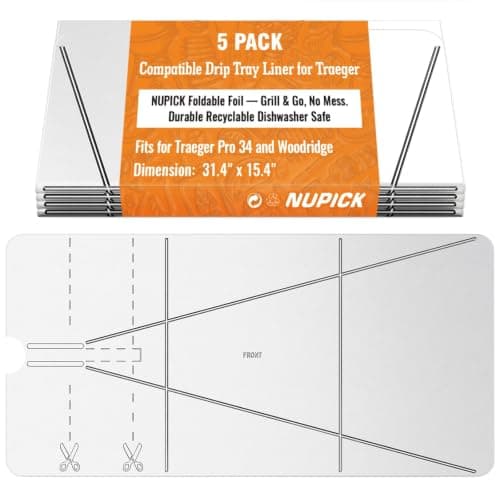
The NUPICK BAC818 liners cover the Pro 34 and the Woodridge. The Woodridge is the interesting case: it is a current-generation grill with EZ-Clean grease routing and a drip tray, so a Woodridge owner gets the most out of buying both these tray liners and the keg liners below. The tray liner catches fat before it bakes onto the tray; the keg liner means the keg underneath empties as a bag.
For a grill this new, liner availability is a genuine consideration — the aftermarket is still filling in, which is why we name the specific listing we verified rather than telling you to search.
Pros
- Covers the Woodridge, Traeger's current best-selling mid-range grill
- Also fits the Pro 34
- Pairs with the Woodridge keg liners for full grease management
- Verified in stock, which is not guaranteed for new-model consumables
Cons
- Thin aftermarket for a recent model — fewer alternatives if this pack goes out of stock
- A Woodridge really wants two consumables, not one, which doubles the running cost
- Does not fit the Woodridge Pro's keg — that is a separate liner
- Part number BAC818 is not printed on the grill, so you are trusting the listing's fitment claim
Tailgater 20 / 20 Series — BAC408
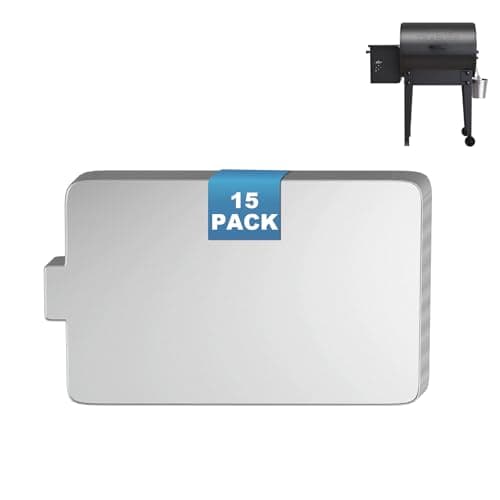
Small grills get used more casually and cleaned less often, which makes a liner more valuable on a Tailgater than on a Timberline. The BAC408 15-pack is the only 20-series pack we verified in stock, and the large count suits the use case — a portable grill that gets thrown in a truck is one you want to be able to re-line without thinking about it.
The honest note is that it is the highest total price of any pack on this page, because you are buying fifteen at once rather than five. Per liner it is reasonable; as a single purchase for a small grill it feels steep.
Pros
- Correct BAC408 fit for the Tailgater 20 and other 20-series grills
- 15-pack count suits a portable grill that gets cleaned irregularly
- Reasonable cost per liner despite the high total
- The only 20-series pack we found live and in stock
Cons
- Highest total price of any pack here, because of the 15-count
- More liners than a casual tailgate user will get through in a few seasons
- No smaller pack available for this size at the time of writing
- Small liners are the easiest to crease during storage, which hurts the seal
Grease and ash keg liners — Timberline, Ironwood, Woodridge™, Flatrock
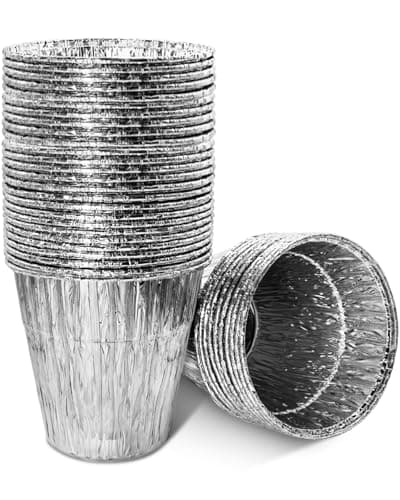
If your Traeger has a pull-out grease and ash keg rather than a bucket on a hook, this is your consumable. The Matchwaves BAC608 25-pack covers the current Timberline, Ironwood, Woodridge and the Flatrock griddle, and the 25-count is the best value per liner of anything on this page. There is also a Woodridge and Woodridge Pro specific pack if you would rather buy against your exact model.
This is the single most worthwhile liner purchase on the page, for an unglamorous reason: ash and grease together set into a cement-like crust in an unlined keg, and a bagged keg is a ten-second job instead of a ten-minute one.
Pros
- Best cost per liner of anything on this page at a 25-count
- Covers Timberline, Ironwood, Woodridge and Flatrock in one pack
- Turns the worst cleaning job on a modern Traeger into a ten-second task
- A model-specific Woodridge and Woodridge Pro pack is available as an alternative
Cons
- Useless on older grills with a hanging drip bucket — check which you have first
- 25 liners is a lot of packaging to store
- Does not replace a drip tray liner on grills that have both
- Third-party fitment claim; confirm your keg shape against the listing photos
How to Use a Drip Tray Liner Properly
Three habits do most of the work.
Seat it flat and all the way into the corners. A liner sitting proud of the tray edge channels grease underneath itself, which defeats the whole point. Press it into the corners before the grates go back in.
Change it on a schedule, not on inspection. Every three to five cooks, or immediately after any single fatty cook. Grease that pools and then bakes is what feeds flare-ups.
Replace the liner and clean the chute. A liner protects the tray; it does nothing for the grease chute below it. The chute is where the actual blockages happen, and a blocked chute backs grease up into the cook chamber. Scrape it whenever you change the liner.
Never line anything the manual does not tell you to. Foil or liners over the heat baffle, inside the firepot area, or across the grease chute will block airflow or trap grease in the worst possible place. The drip tray is the only surface in the cook chamber designed to be lined.
For the rest of the routine, our how to clean a Traeger grill guide walks through a full clean step by step, and the Traeger maintenance schedule lays out what to do at what interval. If you are chasing stubborn baked-on grease on the tray itself rather than preventing it, the best degreasers for pellet grills roundup covers the cleaners that cut it.
Liners Versus Foil Versus Nothing
To be straight about the alternatives, because people ask.
Heavy-duty aluminum foil is a legitimate budget option on the drip tray and costs a fraction of a pre-cut liner. Its failure modes are tearing on removal and not lying flat enough to stop grease escaping around the edges. Double it, crease it into the corners, and it works.
Nothing at all is also a defensible choice, as long as you actually scrape the tray on a schedule. A clean bare tray is safer than a liner you leave in place for a season. The liner's value is that it makes the right behavior easy, not that it does anything the tray cannot.
Liners win on exactly one axis: effort. If the reason your drip tray is filthy is that cleaning it is annoying, a liner fixes that, and a grease fire is a far more expensive problem than a pack of aluminum trays. Buy against the part number, change them when they fill, and scrape the chute while you are in there.
Pack counts and prices in this category change constantly, so check the live number on each button rather than planning around anything written here. Our wider pellet grill accessories roundup covers what else is worth owning, and two other guides take the same fitment-first approach to accessories people routinely buy in the wrong size: the pellet grill cover buying guide and, if you cook through the cold months, our best pellet grill insulation blankets picks matched by model and part number.