
How Long to Smoke a Brisket: Complete Time & Temp Guide
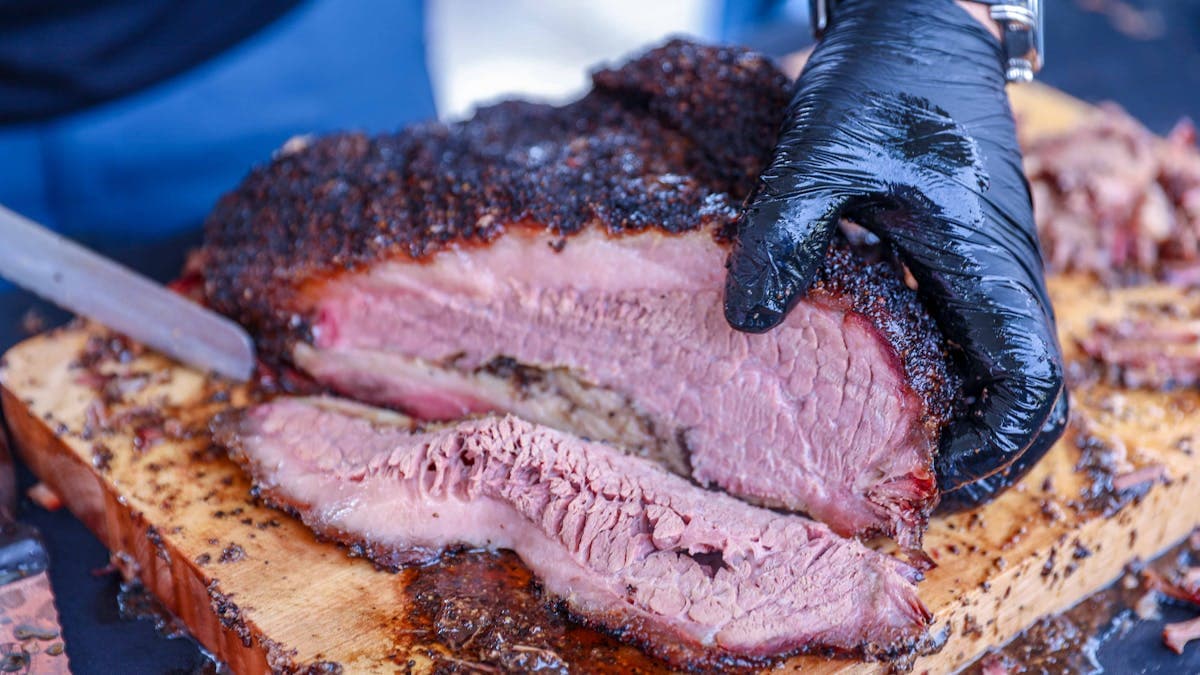
The number one question every new brisket smoker asks is: how long does it take to smoke a brisket? The honest answer is that it depends — on the size of the brisket, the cooking temperature, whether you wrap, and the quirks of your specific cut of beef. But there are reliable guidelines that will get you in the right ballpark every time.
This guide breaks down brisket timing at every common smoking temperature, explains the stall, and gives you a planning framework so you can serve perfectly smoked brisket on schedule. Whether you are cooking a weekend brisket on your Traeger® or planning an overnight cook for a party, you will find the timing information you need right here.
Brisket Time Per Pound at Every Temperature
The table below shows estimated cook times for a full packer brisket, including the stall. These times assume you wrap in butcher paper at 165°F internal temperature.
| Smoking Temp | Time Per Pound (Wrapped) | 12 lb Brisket | 15 lb Brisket | 18 lb Brisket |
|---|---|---|---|---|
| 225°F | 1 - 1.5 hrs/lb | 12-18 hrs | 15-22 hrs | 18-27 hrs |
| 250°F | 45 min - 1.25 hrs/lb | 9-15 hrs | 11-19 hrs | 13-22 hrs |
| 275°F | 40 min - 1 hr/lb | 8-12 hrs | 10-15 hrs | 12-18 hrs |
| 300°F (hot & fast) | 30-45 min/lb | 6-9 hrs | 7-11 hrs | 9-13 hrs |
Important notes about these ranges:
- The wide ranges account for natural variation between briskets. Two 14-pound briskets cooked side by side at the same temperature can finish hours apart.
- Wrapping at 165°F typically saves 2 to 4 hours compared to cooking unwrapped.
- These times do not include resting time. Add 1 to 4 hours for resting in a cooler.
- Outdoor temperature and wind affect cook time. Cold, windy conditions can add 1 to 2 hours.
Understanding the Brisket Stall
The stall is the single biggest variable in brisket cook time, and understanding it is essential for planning your cook.
What Is the Stall?
The stall occurs when the internal temperature of the brisket plateaus, typically between 150 and 170°F. The temperature may hold steady or even drop slightly for 2 to 6 hours. This happens because moisture evaporating from the surface of the brisket cools the meat at the same rate that the grill is heating it — similar to how sweat cools your body.
How Long Does the Stall Last?
The stall duration depends on several factors:
- Brisket size — Larger briskets have more surface area and moisture, so the stall lasts longer.
- Cooking temperature — Higher temperatures push through the stall faster because the heat input exceeds the evaporative cooling rate sooner.
- Humidity — Humid conditions reduce evaporation and shorten the stall.
- Whether you wrap — Wrapping traps moisture and heat, breaking through the stall in about 30 minutes.
At 225°F without wrapping, the stall can last 4 to 6 hours. With a butcher paper wrap at 165°F, you bypass most of it.
To Wrap or Not to Wrap?
| Method | Pros | Cons |
|---|---|---|
| Butcher paper | Preserves bark texture, reduces stall by 2-3 hrs, allows some moisture escape | Bark softens slightly, more expensive than foil |
| Aluminum foil | Fastest stall break (saves 3-4 hrs), retains maximum moisture | Bark becomes soft/mushy, can make meat too steamy |
| No wrap | Best bark development, maximum smoke flavor | Longest cook time (add 3-5 hrs), higher risk of drying the flat |
Most pitmasters (including us) recommend butcher paper as the best balance of bark preservation and cook time reduction.
Equipment You Will Need
The right gear makes long brisket cooks manageable:
- Traeger® Ironwood Pellet Grill — rock-steady temperature control for 12+ hour cooks, with Super Smoke mode for maximum flavor
- Traeger® Hickory Hardwood Pellets — the classic choice for brisket; bold, traditional smoke flavor
- MEATER Plus Wireless Thermometer — essential for monitoring overnight cooks without opening the lid
- ThermoWorks Thermapen ONE — for the probe tenderness test that determines when the brisket is truly done
- ThermoWorks Signals — 4-channel thermometer for monitoring multiple spots simultaneously
- Traeger® Drip Tray Liners — briskets produce significant drippings over a long cook
- Pink butcher paper — unwaxed, uncoated, food-grade; an 18-inch roll wraps a full packer
- An insulated cooler for resting
Ingredients
Brisket seasoning is intentionally simple. The beef and smoke should be the stars.
- 1 full packer brisket (12-18 lbs) — USDA Choice or Prime. See our Traeger brisket recipe for detailed selection and trimming guidance.
- Coarse black pepper (16-mesh) — the primary flavor in a Texas-style brisket rub
- Kosher salt — Diamond Crystal preferred
- Granulated garlic — adds depth without competing with the beef
For a deeper dive into rub ratios and variations, see our best brisket rub recipe.
Step-by-Step Instructions
Step 1: Select and Trim the Brisket
Choose a brisket with good flexibility (it should bend when you pick it up from the middle), even thickness in the flat (at least 1 inch at the thinnest point), and visible marbling. Trim the fat cap to 1/4 inch and remove any hard, waxy fat deposits that will not render at smoking temperatures.
For a detailed trimming walkthrough, see our complete Traeger brisket recipe.
Step 2: Season with SPG
Pat the brisket dry, apply a thin coat of yellow mustard as a binder, and season generously with a mixture of coarse black pepper, kosher salt, and granulated garlic (roughly 2:1:1 ratio by volume). Let the seasoned brisket sit at room temperature for 30 to 45 minutes while the grill preheats.
Step 3: Smoke at Your Chosen Temperature
The temperature you choose determines the character of the finished brisket:
225°F — Classic Low and Slow
- Maximum smoke absorption and smoke ring development
- Most tender results with the longest cook time
- Best for: weekend cooks when you have time, competition brisket
- Time estimate: 1 to 1.5 hours per pound
250°F — The Sweet Spot
- Great balance of smoke flavor and reasonable cook time
- Many competition teams use this temperature
- Best for: when you want great results without a 20-hour commitment
- Time estimate: 45 minutes to 1.25 hours per pound
275°F — Hot and Fast(er)
- Darker, crustier bark with slightly less smoke penetration
- Significantly shorter cook time
- Best for: weeknight briskets, feeding a crowd on a schedule
- Time estimate: 40 minutes to 1 hour per pound
Set the Traeger® to your chosen temperature and preheat for 15 minutes. Place the brisket fat-side down with the point end toward the firebox. Insert a leave-in probe into the thickest part of the flat. Close the lid and smoke.
If your Traeger® has Super Smoke mode, use it for the first 2 to 3 hours regardless of your cooking temperature. This phase is when the meat absorbs the most smoke.
Step 4: Wrap at the Stall (165-170°F Internal)
When the internal temperature reaches 165 to 170°F and the bark is firmly set (dark mahogany, dry and firm to the touch), remove the brisket and wrap it in pink butcher paper. Return to the grill seam-side down.
Timing the wrap by temperature:
| Smoking Temp | Approximate Time to Reach 165°F |
|---|---|
| 225°F | 6-8 hours |
| 250°F | 5-7 hours |
| 275°F | 4-6 hours |
| 300°F | 3-5 hours |
Step 5: Pull at Probe Tender (195-210°F)
Continue cooking the wrapped brisket until the internal temperature reaches 200 to 205°F and a probe slides in with zero resistance. Check multiple spots. The brisket may test done anywhere from 195°F to 210°F depending on the specific cut.
Timing from wrap to finish:
| Smoking Temp | Approximate Time from Wrap to Done |
|---|---|
| 225°F | 4-6 hours |
| 250°F | 3-5 hours |
| 275°F | 2-4 hours |
| 300°F | 2-3 hours |
Rest: The Forgotten Step
After pulling the brisket, rest it in an insulated cooler for 1 to 4 hours. This step is critical. The juices redistribute, the collagen continues to break down, and the temperature equalizes across the flat and point. A well-rested brisket is noticeably more tender and juicy than one served immediately.
The brisket will hold safely above 140°F for up to 4 hours in a quality cooler.
Planning Your Cook: Working Backward from Serving Time
The best way to plan a brisket cook is to work backward from when you want to eat. Always build in extra time — a brisket that finishes early can rest in a cooler for hours, but a brisket that finishes late keeps your guests waiting.
Example: Serving at 6:00 PM with a 15 lb brisket at 225°F
| Step | Time |
|---|---|
| Target serve time | 6:00 PM |
| Minus 2-hour rest | 4:00 PM (latest pull time) |
| Minus 15-22 hr cook (worst case) | 6:00 PM previous day |
| Plus 45 min prep | 5:15 PM start prep |
In this example, you would start prepping at 5:15 PM the evening before and serve at 6:00 PM the next day. If the brisket finishes at 2:00 PM instead of 4:00 PM, it simply rests longer in the cooler — which only makes it better.
The golden rule: always start earlier than you think you need to. A brisket that rests for 4 hours is better than a brisket that was rushed.
Pro Tips for Timing a Perfect Brisket
- Always plan for the long end of the range. A 15-pound brisket at 225°F could take 15 hours or 22 hours. Plan for 22 and be pleasantly surprised if it finishes early.
- Use a wireless thermometer for overnight cooks. A MEATER Plus or ThermoWorks Signals lets you monitor the cook from bed.
- Do not chase a number. 203°F is a guideline, not a rule. The probe tenderness test is the definitive indicator of doneness. Some briskets are done at 198°F; others need to hit 208°F.
- The flat and point finish at different times. The flat (thinner, leaner) often probes tender 5 to 10 degrees before the point. When the flat probes like butter, the brisket is done.
- Wind and cold add time. If you are cooking in winter or on a windy day, add 10 to 20 percent to your time estimate. Consider a thermal blanket for the grill.
- Larger briskets do not always take longer. A well-marbled 16-pounder can sometimes finish faster than a lean 12-pounder because the fat renders and conducts heat.
Brisket Flat vs. Full Packer: Timing Differences
If you are cooking a brisket flat only (no point), the timing is different:
| Cut | Weight | Time at 225°F | Time at 275°F |
|---|---|---|---|
| Full packer | 12-18 lbs | 12-22 hrs | 8-15 hrs |
| Flat only | 5-8 lbs | 5-10 hrs | 4-7 hrs |
| Point only | 4-7 lbs | 5-9 hrs | 3-6 hrs |
A flat-only brisket is much more prone to drying out because it lacks the insulation and fat of the point. If you must cook a flat, wrap earlier (at 155 to 160°F) and pull at a slightly lower finished temperature (195 to 200°F).
For the full step-by-step process with trimming, seasoning, and slicing details, see our complete Traeger brisket recipe.
Gear for This Recipe
The kit that decides whether your timing estimate holds:
MEATER Plus Wireless Thermometer
ThermoWorks Thermapen ONE
Bear Mountain Hickory Pellets (40 lb)
Bryco Goods Pink Butcher Paper (18 in x 175 ft)
Frequently Asked Questions
How long does brisket take per pound at 225°F?
At 225°F, plan for 1 to 1.5 hours per pound of trimmed weight. A 14-pound brisket will take approximately 14 to 21 hours, including the stall. Wrapping at 165°F internal typically reduces total cook time by 2 to 4 hours. Variables like outdoor temperature, wind, humidity, and the specific brisket will affect timing.
Can I smoke a brisket overnight on a Traeger?
Yes. An overnight cook is one of the best strategies for brisket. Start the brisket at 225°F in the evening, let it smoke through the night while you sleep, and wrap it in the morning. Use a wireless thermometer like the MEATER Plus to monitor the cook from your phone. The Traeger® maintains temperature automatically.
Is it better to smoke brisket at 225 or 275°F?
Both temperatures produce excellent brisket. At 225°F, you get maximum smoke penetration, a thicker smoke ring, and more tender results, but the cook takes 14 to 18 hours. At 275°F, you cut the cook time to 8 to 12 hours with a darker, crustier bark but slightly less smoke flavor. Many competition pitmasters use 250°F as a sweet spot.
How long does the brisket stall last?
The stall typically begins between 150 and 165°F and can last 2 to 6 hours without wrapping. The duration depends on brisket size, humidity, and cooking temperature. Wrapping in butcher paper or foil at 165°F breaks through the stall and saves 2 to 4 hours.
Should I cook the flat or the whole packer, and does it change timing?
A whole packer brisket (flat plus point) is strongly recommended. The point overlaps the flat and insulates it during cooking, helping the flat stay moist. A flat-only brisket cooks faster (roughly 1 hour per pound at 225°F) but is much more prone to drying out.
Never Miss Your Target Temp
The ThermoWorks Signals 4-channel thermometer monitors up to four spots on your brisket simultaneously, with high and low alarms that alert you on your phone.
What to Cook Next
Ready to put these timing guidelines into practice? Start here:
- Traeger Brisket Recipe — The complete step-by-step recipe with trimming, seasoning, and slicing instructions.
- Best Brisket Rub Recipe — Master the classic SPG rub and explore advanced variations.
- Smoked Chuck Roast (Poor Man's Brisket) — Practice brisket technique on a smaller, cheaper cut before committing to a full packer.
- Smoked Pastrami from Corned Beef — The same wrap-at-165°F, finish-at-203°F timeline applied to a cured brisket flat.
Browse all of our Traeger® recipes for more inspiration.
Timing and finished temperatures for every other cut are in our smoking time and temperature chart.
Explore more: Traeger Recipe Collection | Best Wood Pellets for Brisket | All Recipes