
Traeger Brisket Recipe: The Ultimate Guide to Smoked Brisket
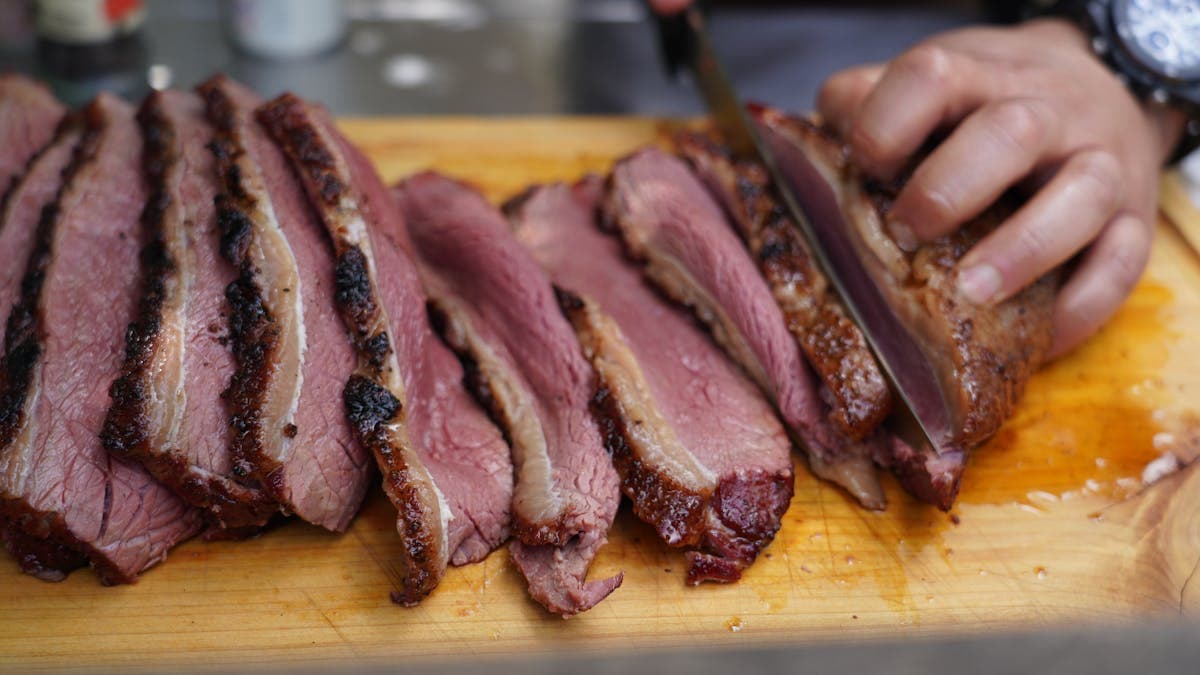
Smoking a whole packer brisket is the ultimate test of a pitmaster's skill, and it is one of the most rewarding things you can cook on a Traeger® pellet grill. A properly smoked brisket has a jet-black bark that cracks when you slice through it, a deep pink smoke ring, and meat so tender it jiggles on the cutting board. The fat renders into the meat during the long cook, creating a buttery texture and rich beef flavor that no other cooking method can replicate.
This is not a quick weeknight dinner. A full packer brisket takes 12 to 14 hours on the smoker, plus resting time. But the beauty of a Traeger® is that the pellet-fed fire maintains a rock-steady temperature the entire time, meaning you do not have to babysit a firebox or adjust vents every hour. Set it, monitor the probe, and let the grill do the work.
This guide covers everything: how to select the right brisket, trim it properly, season it with a classic Texas-style rub, and smoke it low and slow until it is fall-apart tender.
Why Brisket Is the King of the Traeger
Brisket and pellet grills are a perfect match, and here is why:
- Consistent temperature control — The Traeger® maintains 225°F for 12+ hours without intervention. Offset smokers require constant fire management; the Traeger® handles it automatically.
- Even heat distribution — The convection-style cooking in a Traeger® circulates heat evenly around the brisket, reducing hot spots that can dry out the flat.
- Set-and-forget convenience — With WiFIRE-enabled models, you can monitor your cook from your phone. Start the brisket before bed and check it when you wake up.
- Reliable smoke production — Hardwood pellets produce clean, consistent smoke throughout the entire cook. No need to add wood chunks or manage a fire.
Choosing Your Brisket
Start with a USDA Choice or Prime full packer brisket weighing 12 to 15 pounds. The full packer includes both the flat (the lean, thin end) and the point (the fatty, thick end), connected by a layer of fat called the deckle.
What to look for:
- Flexibility — Pick up the brisket from the middle. A good brisket will bend and flex. A stiff brisket has more connective tissue and may not break down as well.
- Even thickness — The flat should be at least 1 inch thick at its thinnest point. Paper-thin flats dry out during long cooks.
- Marbling — Look for visible white streaks of intramuscular fat throughout the meat, especially in the flat. More marbling means more moisture and flavor.
- Grade — USDA Prime has the most marbling and is the most forgiving. Choice is the sweet spot for value. Select grade briskets are leaner and harder to keep moist.
Plan on about 1 pound of raw brisket per person. A 14-pound brisket will yield roughly 8 to 9 pounds of cooked meat after trimming and moisture loss.
Equipment You Will Need
The right equipment makes a long brisket cook much easier to manage — and if you are still choosing a smoker, start with our roundup of the best pellet grills for brisket:
- Traeger® Ironwood Pellet Grill — the large cooking surface fits a full packer with room to spare, and Super Smoke mode maximizes flavor during the first few hours
- Traeger® Hickory Hardwood Pellets — hickory delivers the bold, traditional smoke flavor that brisket demands
- ThermoWorks Thermapen ONE — essential for checking probe tenderness when deciding whether the brisket is done
- MEATER Plus Wireless Thermometer — leave-in wireless probe lets you monitor the cook from your phone overnight
- Traeger® Drip Tray Liners — a full brisket produces significant drippings; liners make cleanup effortless
- Pink butcher paper — unwaxed, uncoated, food-grade; an 18-inch roll is wide enough to wrap a full packer
- A sharp boning knife or trimming knife
- A large insulated cooler (for resting)
Ingredients
- 1 whole packer brisket (12-15 lbs) — USDA Choice or Prime. Do not buy a brisket flat only; the point provides the juiciest, most flavorful meat.
- 1/4 cup coarse black pepper (16-mesh) — the foundation of any Texas-style brisket rub. Coarse grind stays on the surface and creates a crunchy bark. See our best brisket rub recipe for more detail on the pepper grind.
- 1/4 cup kosher salt — use Diamond Crystal kosher salt if possible; it is less salty by volume than Morton's, which is easier to control.
- 2 tablespoons granulated garlic — adds depth without competing with the beef and smoke.
- 1 tablespoon onion powder — optional but rounds out the garlic.
- 2 tablespoons yellow mustard (binder) — helps the rub adhere. Burns off completely during cooking; you will not taste it.
- Beef tallow or butter (optional) — spread on butcher paper when wrapping for extra richness and moisture.
- Pink butcher paper — allows some moisture to escape (preserving bark) while still pushing through the stall. Foil works too but can make the bark soft.
Step-by-Step Instructions
Step 1: Trim the Brisket (20-30 Minutes)
Trimming is where many brisket cooks go wrong. The goal is to create an aerodynamic shape that cooks evenly while removing fat that will not render during the cook.
- Place the brisket fat-side up on a large cutting board. Use a sharp boning knife.
- Trim the fat cap down to approximately 1/4 inch thick across the entire surface. Leave some fat — it bastes the meat during cooking — but remove any thick deposits that are more than 1/2 inch. Hard, waxy fat will not render at smoking temperatures.
- Flip the brisket over (meat side up). Remove the silver skin and any large chunks of hard fat.
- Square off the thin, tapered edges of the flat. These thin pieces will overcook and dry out, so trimming them creates a more even cook.
- Remove any loose flaps of meat that would burn.
- Save the trimmings. You can grind them into burger meat or render the fat into beef tallow for your next cook.
A well-trimmed brisket should look uniform and somewhat aerodynamic, with no thick fat deposits or dangling pieces.
Step 2: Season the Brisket (15 Minutes)
The classic Texas-style brisket rub is simple: coarse black pepper, kosher salt, and garlic. The philosophy is that high-quality beef with clean smoke does not need anything else.
- Pat the trimmed brisket completely dry with paper towels.
- Apply a thin coat of yellow mustard over all surfaces. This is your binder — it helps the rub stick and burns off during cooking.
- Mix the coarse black pepper, kosher salt, granulated garlic, and onion powder in a shaker bottle or bowl.
- Apply the rub generously and evenly over the entire brisket — top, bottom, sides, and ends. Do not be shy. Brisket is a thick cut and it can handle aggressive seasoning.
- Let the seasoned brisket sit at room temperature for 30 to 45 minutes while the Traeger® preheats. This brings the surface temperature up slightly for better smoke adhesion.
For more rub variations and tips on getting the perfect bark, check out our best brisket rub recipe.
Step 3: Smoke at 225°F (6-8 Hours)
This is the long, slow phase where the magic happens. Low temperature plus hardwood smoke creates the bark and smoke ring that define great brisket.
- Fill the hopper with Traeger® Hickory Pellets. Mesquite is also excellent for brisket if you want a bolder flavor — use Traeger® Mesquite Pellets for an authentic Texas taste.
- Set the Traeger® to 225°F and allow 15 minutes to preheat. If your model has Super Smoke mode, use it for the first 2 to 3 hours for maximum smoke penetration.
- Place the brisket fat-side down on the grill grates. Position the point (thick end) toward the firebox where the heat is slightly higher. Fat-side down protects the flat from direct heat and helps the fat cap render.
- Insert a leave-in meat probe (like the MEATER Plus) into the thickest part of the flat.
- Close the lid and do not open it for at least 3 hours. Every time you open the lid, you lose heat and smoke. Resist the temptation.
- After 3 hours, you can start checking the bark development. Continue smoking until the internal temperature reaches 165 to 170°F and the bark is a deep mahogany color, firm, and dry to the touch. This typically takes 6 to 8 hours total.
Optional spritz: Some pitmasters spritz the brisket with apple cider vinegar or a 50/50 mix of apple cider vinegar and water every 90 minutes after the first 3 hours. This adds a subtle flavor layer and may help bark formation. Others argue it extends the cook time by cooling the surface. Both approaches produce great brisket.
Step 4: Wrap the Brisket (The Texas Crutch)
Wrapping serves two purposes: it pushes through the stall (where evaporative cooling plateaus the internal temperature) and it retains moisture in the flat.
- When the internal temperature hits 165 to 170°F and the bark is set, remove the brisket from the grill — a 14-pound packer is heavy and slick, so heat-resistant gloves beat tongs for getting it onto the paper in one piece.
- Lay out two overlapping sheets of pink butcher paper on a table, long enough to fully wrap the brisket.
- Optional: Spread 2 to 3 tablespoons of beef tallow or butter across the paper where the brisket will rest. This adds richness and helps keep the flat moist.
- Place the brisket on the paper and wrap it tightly, folding the edges snugly to create a sealed package. The wrap should be snug but not so tight that it crushes the bark.
- Return the wrapped brisket to the grill, seam-side down, and reinsert the probe through the paper.
Butcher paper vs. foil: Butcher paper is porous, which allows some moisture to escape and preserves the bark's texture. Foil creates a completely sealed environment that speeds up cooking but can make the bark soft and mushy. Most competition pitmasters use butcher paper.
Step 5: Finish to 203°F (4-6 Hours)
- Continue cooking the wrapped brisket at 225°F. The temperature will climb more quickly now that the stall is broken.
- Begin checking for doneness when the internal temperature reaches 195°F. The magic number is 203°F, but probe tenderness is the real indicator.
- Use your Thermapen ONE to probe multiple spots in both the flat and the point. The probe should slide in and out with absolutely zero resistance — like inserting it into warm butter.
- If there is any tug or resistance in any spot, keep cooking. A brisket that probes tender at 198°F is done; one that is tight at 206°F needs more time.
Step 6: Rest for 1 to 2 Hours (Minimum)
Resting is not optional. It is one of the most important steps in the entire cook.
- Remove the wrapped brisket from the grill.
- Place it in a large insulated cooler lined with a towel on the bottom.
- Cover with another towel and close the lid.
- Rest for a minimum of 1 hour. Two hours is ideal. Many competition pitmasters rest for 3 to 4 hours.
- The brisket will stay above 140°F (the food safety zone) for up to 4 hours in a well-insulated cooler.
- During the rest, the internal temperature equalizes, juices redistribute throughout the meat, and the collagen continues to break down. This results in noticeably more tender, juicy slices.
Slicing: When ready to serve, unwrap the brisket. Separate the flat from the point by cutting along the fat layer between them. Slice the flat against the grain in pencil-thick slices (about 1/4 inch). The point can be sliced thicker, cubed for burnt ends, or chopped for sandwiches.
Pro Tips for the Best Traeger Brisket
- Buy the best brisket you can afford. The quality of the raw brisket matters more than any technique or rub. Prime grade with heavy marbling will produce a more forgiving, juicier result than Select grade.
- Trim with a cold brisket. Cold fat is firm and much easier to cut cleanly. Take the brisket straight from the refrigerator for trimming, then let it come to room temperature after seasoning.
- Fat-side down on a Traeger. Because the heat source is below the grates, fat-side down protects the flat from direct heat. The fat cap acts as an insulator.
- Do not wrap too early. Let the bark fully set before wrapping. If the bark is still tacky or soft when you touch it, give it more time. Wrapping a brisket with a soft bark will steam the bark off.
- Trust the probe, not the thermometer. Internal temperature is a guideline, not a finish line. Probe tenderness is the definitive test for doneness.
- Rest longer than you think you need to. If you have to choose between starting your brisket an hour early or an hour late, always start early. A brisket that rests for 3 hours in a cooler will be better than one that rests for 30 minutes.
Variations to Try
Hot and Fast Brisket (275°F)
If you do not have 14 hours, you can smoke the brisket at 275°F for a faster cook (8 to 10 hours total). The bark will be slightly different — darker and crustier — and you will get less smoke penetration, but the results are still excellent. Wrap at the same internal temperature (165°F) and pull at 203°F.
Peppercorn-Only Texas Brisket
For a truly minimalist approach, skip the garlic and onion powder. Use only coarse black pepper and kosher salt in a 50/50 ratio. This is how many of the legendary Texas BBQ joints season their briskets, and the simplicity lets the beef and smoke shine.
Coffee-Rubbed Brisket
Add 2 tablespoons of finely ground dark roast coffee to the base SPG rub. The coffee adds an earthy bitterness that complements the pepper and creates an exceptionally dark, complex bark.
Gear for This Recipe
What a 12-hour packer cook actually runs on:
Bear Mountain Hickory Pellets (40 lb)
MEATER Plus Wireless Thermometer
ThermoWorks Thermapen ONE
Bryco Goods Pink Butcher Paper (18 in x 175 ft)
Frequently Asked Questions
When should I wrap my brisket on the Traeger?
Wrap the brisket when the internal temperature reaches 165 to 170°F and the bark has set. The bark should feel firm and dry to the touch, and the surface should be a deep mahogany color. Wrapping at this point pushes through the stall and preserves moisture without sacrificing bark quality.
What is the stall and how do I get through it?
The stall happens when evaporative cooling on the brisket's surface causes the internal temperature to plateau, typically between 150 and 170°F. It can last several hours. Wrapping in butcher paper or foil is the most effective way to push through the stall. The wrap traps heat and moisture, preventing evaporative cooling while still allowing some smoke penetration if using paper.
How long should I rest a brisket after smoking?
Rest the brisket for a minimum of 1 hour, but 2 hours is ideal for the best texture. Place the still-wrapped brisket in an insulated cooler lined with towels. The brisket will hold above 140°F safely for up to 4 hours, and many competition pitmasters rest for 3 to 4 hours for maximum tenderness.
What internal temperature is a brisket done?
The target internal temperature is 203°F, but probe tenderness matters more than the exact number. Some briskets are done at 198°F and others at 208°F. Insert a probe or skewer into the brisket — it should slide in with zero resistance, like poking warm butter. Check multiple spots in both the flat and the point.
Can I smoke a brisket on a Traeger overnight?
Yes, and many pitmasters prefer overnight cooks. Start the brisket in the evening at 225°F and let it smoke through the night. By morning, it will be ready to wrap. Use a wireless thermometer like the MEATER Plus to monitor the temperature from your phone. The Traeger® will maintain temperature automatically, so you can sleep through most of the cook.
The Best Grill for Brisket
The Traeger Ironwood delivers rock-steady temperatures and Super Smoke mode for maximum bark and smoke ring. Built for serious cooks who demand competition-level results.
What to Cook Next
Now that you have tackled the king of BBQ, keep building your skills with these recipes:
- Smoked Pulled Pork on Traeger — Another low-and-slow classic that is more forgiving than brisket.
- Best Brisket Rub Recipe — Deep dive into SPG ratios, pepper grinds, and advanced rub variations.
- Smoked Chuck Roast (Poor Man's Brisket) — Practice your brisket technique on a smaller, cheaper cut.
- Smoked Beef Ribs (Dino Ribs) — Same salt-and-pepper philosophy, same probe-tender finish, in about 8 hours instead of 14.
- Smoked Pastrami from Corned Beef — Turn a store-bought corned beef into deli pastrami using brisket technique.
- How to Season a New Traeger Grill — Make sure your grill is properly broken in before a long cook.
Browse all of our Traeger® recipes for more inspiration.
Explore more: Traeger Recipe Collection | Best Wood Pellets for Brisket | All Recipes