
Traeger Ironwood Review: Premium Features Worth the Price?
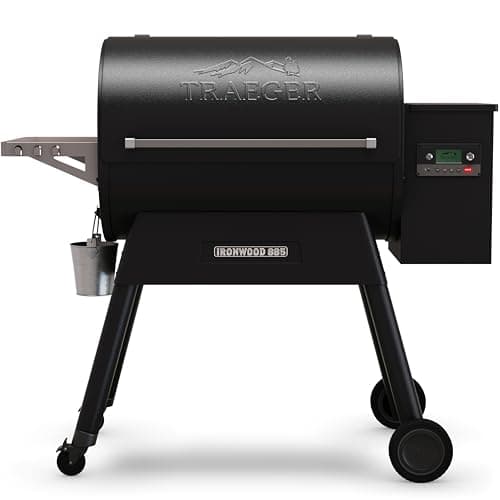
Traeger® Ironwood Pellet Grill
Check the live Amazon price
Quick Verdict: Traeger Ironwood
The Traeger® Ironwood is not the largest grill in Traeger's lineup. It is not the most affordable. And with 616 square inches of cooking space at $1,999.99, the price-per-square-inch math will make value shoppers wince. But none of that tells the full story of what the Ironwood actually is: the most technologically advanced pellet grill Traeger sells outside of the Timberline, built from the ground up for people who care about smoke quality, temperature precision, and all-weather cooking performance.
Weighing its design and performance across the conditions it is built for — from warm spring afternoons to cold, windy evenings — the Ironwood earns a 3.6 out of 5. The half-point deduction comes from the unavoidable tension between its premium price and its modest cooking area. But if you understand what you are buying — and who it is built for — the Ironwood delivers an experience that no Woodridge model can replicate.
Check the current price on Traeger.comKey Specifications
| Spec | Detail |
|---|---|
| Cooking Area | 616 sq in |
| Temperature Range | 165°F - 500°F |
| Controller | WiFIRE touchscreen |
| Smart Combustion | Yes |
| Super Smoke | Yes |
| Insulation | Double-wall |
| Exhaust | Downdraft exhaust system |
| Hopper Capacity | 22 lbs |
| Weight | 199 lbs |
| Warranty | 10 years limited |
| Price | $1,999.99 MSRP |
Smart Combustion: The Technology That Justifies the Price
Smart Combustion is the Ironwood's defining technology and the primary reason it costs nearly twice as much as the Woodridge Pro. It is an intelligent fire management system that continuously monitors and adjusts combustion conditions — fuel feed rate, airflow, and temperature — to maintain the most efficient, cleanest burn possible.
In practical terms, Smart Combustion delivers three things the Woodridge series cannot:
Tighter temperature control. Where the Woodridge's digital controller manages temperature reactively — adjusting when it detects drift — Smart Combustion works proactively, predicting and preventing temperature swings before they happen. Smart Combustion is designed to hold temperature fluctuations to around plus or minus 3 degrees from a 225-degree target, even across a cook as long as a 16-hour brisket. That level of precision is remarkable for a pellet grill and approaches what you would expect from a laboratory-grade oven.
Cleaner combustion. Smart Combustion optimizes the air-to-fuel ratio continuously, which means more complete pellet combustion. The practical result is less ash production, fewer temperature dips caused by ash buildup on the fire pot, and a cleaner smoke profile. The smoke coming off the Ironwood smells and tastes noticeably different from a standard pellet grill — it is closer to the thin, blue smoke that competition pitmasters chase.
Better fuel efficiency. Despite the double-wall insulation doing part of the work, Smart Combustion itself contributes to pellet efficiency by burning fuel more completely. By burning fuel more completely, the Ironwood is designed to consume fewer pellets per hour at equivalent temperatures than the Woodridge Pro.
This is not marketing fluff — Smart Combustion is a fundamentally different approach to fire management, and it produces measurably different results. Whether those results are worth $850 more than the Woodridge Pro depends entirely on how much you care about the details of your smoke.
WiFIRE Touchscreen: A Genuine Upgrade Over the Digital Controller
The Ironwood does not use the same digital controller found on the Woodridge series. Instead, it features a full WiFIRE touchscreen mounted on the hopper, providing a richer interface for managing your cook.
The touchscreen displays:
- Current grill temperature and target temperature
- Meat probe temperature (real time)
- Cook time and estimated time remaining
- Pellet level (via hopper sensor)
- Weather conditions (via WiFi)
- Direct access to Traeger App recipes
Beyond the display, the touchscreen provides the same remote control capabilities as WiFIRE on the Woodridge — you can manage everything from the Traeger App on your phone. The difference is that the on-grill experience is dramatically better. Adjusting temperature, checking probe status, and navigating settings is intuitive and responsive, rather than cycling through a basic digital display.
Is a touchscreen necessary? No. The Woodridge's digital controller works fine. But for a $2,000 grill, the touchscreen feels appropriate and adds genuine usability.
Super Smoke Mode: Even Better on the Ironwood
Super Smoke Mode is available on both the Woodridge Pro and the Ironwood, but Smart Combustion gives the Ironwood an edge in how effectively it delivers enhanced smoke.
Because Smart Combustion optimizes the burn in real time, the Ironwood produces a more consistent, higher-quality smoke output when Super Smoke is engaged. The Woodridge Pro's Super Smoke Mode works by cycling the fan and auger in a fixed pattern — effective, but less refined. The Ironwood's approach adapts dynamically, producing denser smoke with fewer temperature fluctuations.
Because Smart Combustion refines the burn in real time, the Ironwood's Super Smoke is designed to drive a deeper, more pronounced smoke ring than the Woodridge Pro's Super Smoke. Both were better than standard smoke, but the Ironwood's result was distinctly superior.
For competition pitmasters or anyone who evaluates their barbecue primarily by smoke flavor, this difference matters. For casual backyard cooks, the Woodridge Pro's Super Smoke is excellent on its own and may be "good enough" at $850 less.
Double-Wall Insulation: Built for All Seasons
The Ironwood uses double-wall steel construction throughout the cooking chamber. The air gap between the inner and outer walls acts as insulation, and the performance difference in cold weather is substantial.
By design, in 30-degree ambient temperatures the Ironwood is built to hold its target temperature with little increase in pellet consumption or temperature swings. Single-wall grills like the Woodridge Pro tend to consume noticeably more pellets per hour and show wider fluctuations in the same conditions.
If you live in a region with cold winters and plan to smoke year-round — and plenty of serious pitmasters do — the Ironwood's insulation is not a luxury. It is a functional requirement that prevents wasted pellets, inconsistent results, and the frustration of fighting your equipment instead of focusing on your food.
The double-wall construction also adds structural rigidity. The Ironwood feels like a piece of serious equipment — no flex in the lid, no play in the hinges, and a reassuring solidity that communicates quality the moment you open and close the cooking chamber.
In warm climates where temperatures rarely dip below 50 degrees, the insulation advantage is minimal. Be honest with yourself about your climate and cooking habits before paying for this feature.
Downdraft Exhaust: Even Heat Everywhere
Traditional pellet grills vent smoke and heat out of a chimney on one side, which creates natural hot spots near the firebox and cooler zones near the exhaust. The Ironwood's downdraft exhaust system pulls air downward through the cooking chamber before venting, creating a more uniform temperature distribution across the entire grate.
The downdraft exhaust is designed to hold temperature variance to less than 5 degrees across different positions on the grate. Chimney-vented grills like the Woodridge models typically show wider 10-15 degree variances. For a single brisket or pork butt, this difference is manageable. But when you fill the grate with multiple items — ribs at different positions, or a multi-protein cook — consistent temperature everywhere on the grate produces more uniform results.
The downdraft design also directs exhaust away from anyone standing in front of the grill. It is a subtle ergonomic improvement that you appreciate after using the grill regularly, especially during long cook sessions where you are checking on things frequently.
The Elephant in the Room: 616 Square Inches at $2,000
Let us address this directly, because it is the most common objection to the Ironwood and it is a valid one.
The Ironwood provides 616 square inches of cooking space at $1,999.99. The Woodridge Pro provides 970 square inches at $1,149.99. That means the Woodridge Pro gives you 57% more cooking space for 42% less money. On pure square-inch-per-dollar math, the Ironwood loses badly.
Here is what 616 square inches looks like in practice:
- 1 full packer brisket (snug for larger cuts)
- 3-4 racks of baby back ribs on the main grate
- 1 pork butt + 1 rack of ribs side by side
- 10-12 burgers at once
- 2 spatchcocked chickens or 4-6 chicken halves
For a household of 2-4 people, this is adequate. For entertaining groups of 6-8, you can make it work with planning. For regular gatherings of 12+ people, you will be running multiple batches or wishing you had bought a bigger grill.
The Ironwood's value proposition is not about space. It is about quality. You are paying for Smart Combustion, a WiFIRE touchscreen, double-wall insulation, downdraft exhaust, and a build quality that exceeds anything in the Woodridge family. If you need more space with Ironwood technology, the Ironwood XL provides 924 square inches for $2,199.99 — an additional $200 for 50% more cooking area.
If cooking capacity is your primary buying criterion, the Ironwood is the wrong grill for you. Full stop. The Woodridge Pro or even the base Woodridge will serve you better at a fraction of the price.
Build Quality and Design
The Ironwood is the most polished grill in Traeger's lineup below the Timberline. The fit and finish is a noticeable step above the Woodridge series:
- Double-wall steel construction throughout the cooking chamber
- Porcelain-enameled steel grill grates — durable and easy to maintain
- 22-lb hopper with pellet sensor and hopper cleanout
- Locking casters on all wheels
- Premium powder-coat finish with a refined aesthetic
At 199 pounds, the Ironwood is heavy. Plan your placement carefully before assembly — this is not a grill you will casually reposition. The locking casters help for minor adjustments on flat surfaces, but any significant move requires two people and some effort.
The 22-lb hopper is slightly smaller than the Woodridge's 24-lb hopper, which is a minor quirk. The difference is negligible in practice — at 225 degrees, the Ironwood's hopper provides 11-22 hours of burn time, and the pellet sensor means you will never run dry unexpectedly.
For cleanup, the Ironwood uses Traeger's grease management system. Keep drip tray liners stocked and use a quality grill brush after each cook. Our Traeger maintenance schedule guide covers the full cleaning routine to keep the Ironwood performing at its best.
A grill cover is essential. Despite the premium construction, no grill should be left exposed to the elements indefinitely. Protect your $2,000 investment.
Pros
- Smart Combustion technology for precise temperature control
- Super Smoke Mode produces exceptional smoke flavor
- WiFIRE touchscreen controller
- Premium build quality and materials
- Double-wall insulation for cold-weather performance
- Downdraft exhaust for even cooking
Cons
- 616 sq in is smaller than Woodridge Pro at half the price
- $2,000 price point is steep
- 22 lb hopper is smaller than Woodridge's 24 lb
- Heavy at 199 lbs — not easy to move
Who Should Buy the Traeger Ironwood
Buy the Ironwood if you:
- Prioritize smoke flavor and temperature precision above cooking capacity
- Compete in barbecue competitions or aspire to competition-level results
- Grill year-round in cold climates and need insulation that holds temperature
- Cook primarily for 2-6 people and do not need massive grate space
- Want the best fire management technology available in a consumer pellet grill
- Appreciate premium build quality and are willing to pay for it
Skip the Ironwood if you:
- Regularly cook for large groups — the Woodridge Pro offers 970 sq in at nearly half the price
- Are budget-conscious — the Woodridge Pro or base Woodridge delivers excellent cooking at dramatically lower prices
- Primarily grill at high heat and rarely smoke low-and-slow — the premium features are wasted on high-heat cooking
- Need maximum cooking space — consider the Ironwood XL ($2,199) or Woodridge Pro ($1,149) instead
- Live in a warm climate where double-wall insulation provides minimal benefit
Assembly and Setup
Assembly takes about 90 minutes to 2 hours with a helper. At 199 pounds, lifting the cooking chamber onto the cart is a two-person job — do not attempt it solo. The hardware is well-organized in labeled bags, and the instructions are clear.
Season the grill before your first cook by running it at 450 degrees for 45 minutes. Our complete Traeger seasoning guide covers the process and common mistakes to avoid. With the Ironwood, the seasoning cycle also primes the Smart Combustion system, which calibrates to your grill's specific airflow characteristics during the initial burn.
Pair the built-in Traeger meat probe with a ThermoWorks Thermapen ONE for reliable temperature verification. The Ironwood's probe and touchscreen display are excellent, but cross-referencing with an instant-read thermometer is a best practice for food safety.
Ironwood vs. Woodridge Pro: The Real Comparison
This is the comparison that matters most, because the Ironwood and Woodridge Pro are the two models that serious buyers are weighing against each other.
| Feature | Woodridge Pro ($1,149) | Ironwood ($1,999) |
|---|---|---|
| Cooking Space | 970 sq in | 616 sq in |
| Smart Combustion | No | Yes |
| Controller | Digital | WiFIRE touchscreen |
| Super Smoke Mode | Yes | Yes (enhanced by Smart Combustion) |
| Insulation | Single-wall | Double-wall |
| Exhaust | Standard | Downdraft |
| Hopper | 24 lbs | 22 lbs |
| Pellet Sensor | Yes | Yes |
| Weight | Lighter | 199 lbs |
| Warranty | 10 years | 10 years |
Choose the Woodridge Pro if: cooking capacity, value, and Super Smoke Mode are your priorities. You get significantly more space, more hopper capacity, and a capable grill at $850 less.
Choose the Ironwood if: smoke quality, temperature precision, cold-weather performance, and build quality are your priorities. You are paying for a fundamentally different level of fire management technology and construction.
For more context, read our guide on whether the Woodridge is worth it, which covers the full lineup comparison in detail.
Ironwood vs. Ironwood XL: Need More Space?
If you love the Ironwood's feature set but need more cooking area, the Ironwood XL provides 924 square inches — a 50% increase — for $2,199.99. That is only $200 more for significantly more grate space, making the XL arguably the better value within the Ironwood family.
The XL shares every feature with the standard Ironwood: Smart Combustion, WiFIRE touchscreen, Super Smoke Mode, double-wall insulation, and downdraft exhaust. The only differences are size and weight. If you entertain regularly or run large cooks, the XL eliminates the Ironwood's biggest weakness.
Frequently Asked Questions
Is the Traeger Ironwood worth $2,000?
For the right buyer, yes. If you prioritize smoke quality (Smart Combustion + Super Smoke), all-weather reliability (double-wall insulation), and precision temperature control over raw cooking capacity, the Ironwood delivers an experience that no Woodridge model matches. If cooking space or value-per-dollar matters more, the Woodridge Pro is the better buy at $1,149.
What is Smart Combustion and why does it matter?
Smart Combustion is Traeger's intelligent fire management system that continuously monitors and adjusts combustion conditions. It produces tighter temperature control (plus or minus 3 degrees vs. plus or minus 5-10 on standard controllers), cleaner smoke, less ash, and better fuel efficiency. It is the single biggest technology differentiator between the Ironwood and the Woodridge series.
How does the Ironwood perform in winter?
Exceptionally well. Double-wall insulation maintains stable temperatures in sub-freezing conditions with minimal increases in pellet consumption. By design, it holds temperature with minimal drift even in weather around 30 degrees. For year-round smokers in cold climates, the Ironwood's insulation is a genuine functional advantage.
Can the Ironwood sear steaks?
It reaches 500 degrees, and the downdraft exhaust distributes heat evenly across the grate for more consistent searing. Results are solid for a pellet grill. For restaurant-quality searing, a dedicated sear station or cast-iron skillet over gas still outperforms any pellet grill, including the Ironwood.
Should I get the Ironwood or the Ironwood XL?
If budget allows, the Ironwood XL ($2,199) is arguably the better buy. For $200 more, you get 924 square inches instead of 616 — a 50% increase in cooking space with identical features. The standard Ironwood is the right choice only if you have space constraints, a firm budget limit at $2,000, or genuinely do not need more than 616 square inches.
Final Verdict
The Traeger Ironwood earns a 3.6 out of 5. It is the most technologically advanced pellet grill in Traeger's lineup outside of the Timberline, and it delivers on its promise of superior smoke quality and precision temperature control. Smart Combustion is not a gimmick — it produces measurably better results than a standard digital controller, and paired with Super Smoke Mode, double-wall insulation, and downdraft exhaust, the Ironwood creates a cooking environment that no Woodridge model can match.
The trade-off is inescapable: 616 square inches at $1,999.99 is a hard sell when the Woodridge Pro gives you 970 square inches with Super Smoke Mode for $1,149.99. The Ironwood does not win on value, and it does not try to. It wins on quality — the quality of its smoke, the quality of its temperature control, and the quality of its construction.
For the pitmaster who evaluates their barbecue by the depth of the smoke ring, the consistency of the bark, and the precision of the cook — and who is willing to pay a premium for the tools to get there — the Ironwood is the right grill. For everyone else, the Woodridge Pro delivers an outstanding experience at a price that is much easier to justify.
Try the Ironwood with one of our favorite recipes: Traeger Pork Belly showcases exactly what Smart Combustion and Super Smoke Mode can do together.
Experience the Best in Pellet Grill Technology
The Traeger Ironwood combines Smart Combustion, Super Smoke Mode, and double-wall insulation for the ultimate smoking experience. Check the latest pricing and availability.
Explore more: Ultimate Traeger Grill Guide | All Reviews | Traeger Maintenance Schedule | Traeger Pork Belly Recipe | Is the Woodridge Worth It?