
Best Brisket Knife in 2026: 6 Slicers Ranked for Bark and Clean Cuts
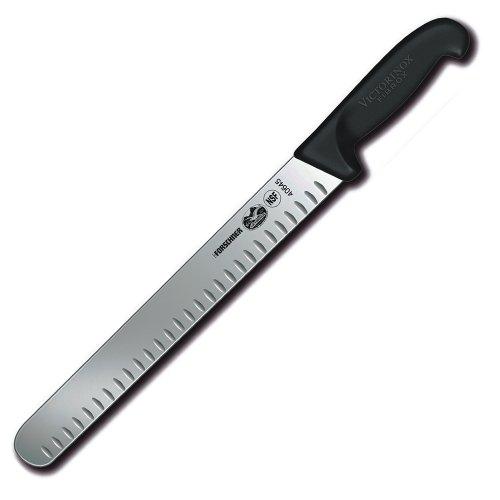
The verdict: the best brisket knife is the Victorinox Fibrox Pro 12-Inch Granton Slicing Knife — a 12-inch granton blade on the textured Fibrox Pro handle, which is the combination that crosses a packer flat in one draw and keeps its grip when your hands are covered in rendered fat. Budget pick: the Mercer Culinary M23112 Millennia, a 12-inch wavy-edge slicer for a fraction of the money, with the compromises that edge brings.
You can smoke a flawless brisket and ruin the last five minutes of it. A short knife forces two or three passes per slice, and each pass drags bark off the top and leaves a torn face. A plain blade lets warm fat vacuum-stick to the steel so slices come off in pieces. A slick handle turns a careful cut into a shove. Slicing is the only part of a 12-hour cook that happens in front of everybody, and it is the cheapest part to fix.
This page ranks six knives: five slicers and the trimming knife that does the other half of the job. All six were verified in stock with a live price at our last price refresh — the table carries the real number with an "as of" date, because we do not type prices into prose.
Quick Picks: Best Brisket Knives
| Knife | Best for | Key specs | Price |
|---|---|---|---|
| 1. Victorinox Fibrox Pro 12-Inch Granton Slicer | Best overall — the one-draw slicer for a packer flat | 12 in blade · granton edge · Fibrox Pro textured handle · stamped blade | |
| 2. Dalstrong Gladiator Elite 12-Inch Brisket Knife | Best heft and finish — a presentation knife that still works | 12 in blade · granton edge · German steel · full tang · G10 handle · sheath | |
| 3. Cutluxe 12-Inch Brisket Carving Knife | Best value — full-tang slicer at closer to budget money | 12 in blade · German steel · full tang · ergonomic handle · sheath included | |
| 4. Mercer Culinary Praxis 12-Inch Granton Slicer | Best granton under $50 — commercial-kitchen tool, home-kitchen price | 12 in blade · granton edge · rosewood handle · hand wash only | $46.65 · View on Amazon Price as of November 20, 2026 |
| 5. Mercer Culinary M23112 Millennia 12-Inch Slicer | Budget pick — cheapest 12-inch blade we would buy | 12 in blade · WAVY edge (not granton) · Millennia textured handle | |
| 6. Victorinox Fibrox Pro 6-Inch Curved Boning Knife | Best for trimming — the knife you use before the cook, not after | 6 in curved blade · semi-stiff · Fibrox Pro handle · fat cap and silverskin |
#ad — the price buttons are affiliate links and we may earn a commission at no extra cost to you. Prices come from Amazon as of November 20, 2026; the live Amazon price always wins. See our affiliate disclosure.
How We Chose
Research-based, as everywhere on this site: published specs and construction from the listing and the maker, treated as claims rather than test results; a live-listing and availability check before a knife goes on a list; and the patterns that repeat across verified owner reviews. We do not run a test kitchen and we are not going to invent a side-by-side of 40 briskets.
What we rank on, in order:
1. Blade length. This is the first filter and it eliminates most kitchen knives. A trimmed packer flat is commonly 10 to 14 inches across, and a brisket knife's job is to cross that in one continuous draw. Two passes mean a stepped, ragged face; three mean bark lifting off the top. Twelve inches handles almost any home brisket; every slicer on this page is 12 inches for that reason.
2. Edge type, which is the real argument. Three options exist and they behave differently:
- Granton (scalloped) edge — oval dimples ground into both sides of the blade near the edge. They create air pockets that break the suction between wet meat and steel, so slices release instead of clinging. This is the right edge for brisket and it is what four of the five slicers here use.
- Plain edge — cuts just as cleanly and sticks more. Perfectly usable, slightly more work per slice.
- Wavy or serrated edge — saws through crust easily, which sounds ideal for bark and is not. The teeth tear the soft interior of a well-rendered flat, leave a fuzzy face, and cannot be re-sharpened properly without specialist gear. It earns a place at the bottom of this page on price, not on performance.
3. Grip when greasy. Underrated and decisive. At slicing time your hands are coated in rendered fat whether you planned it or not. A textured synthetic handle — Victorinox's Fibrox, Mercer's Millennia, a molded G10 — holds on. A smooth polished wood handle is beautiful and gets slippery, which is a real consideration on a long blade.
4. Steel and sharpenability. The German-steel knives here (Cutluxe, Dalstrong) take an edge easily and come back fast on a honing rod; harder Japanese steels hold longer and are fussier to maintain. For a knife used a handful of times a month on boneless meat, easy to re-hone beats maximum edge retention, which is part of why a mid-priced stamped slicer is our overall pick over something prettier.
5. Whether the knife is the right tool at all. A 12-inch slicer is for slicing. Trimming a cold brisket means curving around a fat cap and under silverskin, which needs a short flexible blade — hence the boning knife at number six. Buying one knife for both jobs is the most common mistake in this category.
1. Victorinox Fibrox Pro 12-Inch Granton Slicing Knife — Best Overall
Victorinox Fibrox Pro 12-Inch Granton Slicing Knife
The Victorinox Fibrox Pro Slicing Knife is the knife we would hand to someone slicing their first brisket and the one we would still be using in ten years. The listing is exactly what it needs to be: 12-inch blade, granton edge, Fibrox Pro handle. No damascus pattern, no gift box, nothing you pay for twice.
Who it is for: anyone who wants the professional-kitchen answer. The Fibrox Pro line is the workhorse found on commercial prep lines, and the reason is this specification — light stamped blade, aggressive non-slip handle, easy to bring back to sharp.
Three things make it the top pick for brisket specifically. The granton scallops do what they are supposed to: slices fall away from the blade instead of adhering, which is most of the difference between a clean face and a mauled one. The light stamped blade means the knife follows your hand rather than its own momentum — on a long pull across a flat, control beats heft. And the Fibrox handle is the most secure grip here when greasy; it looks like nothing and outperforms every polished handle in the category at exactly the moment it matters.
The honest trade: it is a plain-looking tool. There is no sheath in the box, so you need a block, a magnetic strip or a blade guard, and a 12-inch blade loose in a drawer is a genuine hazard. The stamped blade flexes slightly more than a forged one, which a few cooks dislike on a very thick point. It also sits at a real price — this is not the cheap pick, it is the sensible one.
Pros
- 12-inch granton edge — the correct specification for brisket, nothing extra
- Fibrox Pro handle keeps its grip with greasy hands
- Light stamped blade gives control over a long pull
- Hones back to sharp quickly and easily
- Commercial-kitchen durability at a mid-market price
Cons
- No sheath or guard included — you need somewhere safe to keep it
- Plain, utilitarian looks; nothing presentation-grade about it
- Stamped blade flexes a little more than a forged one
- Hand wash and dry immediately, despite being a tough knife
2. Dalstrong Gladiator Elite 12-Inch Brisket Knife — Best Heft and Finish
Dalstrong Gladiator Elite 12-Inch Brisket Slicing Knife
The Dalstrong Gladiator Elite is the knife to buy if you want the slicing to feel like an event. Dalstrong lists a 12-inch granton-edge blade in German steel, a full tang, a black G10 handle and a sheath included — and markets it as a brisket knife specifically rather than as a carving knife that happens to be long.
Who it is for: the cook who serves brisket to an audience, and anyone who prefers a substantial knife in the hand. Full-tang construction and a weightier blade give a planted, deliberate feel through a thick point that lighter stamped knives do not.
The G10 handle deserves credit: it is a composite laminate, dense, impervious to moisture and textured enough to stay secure when greasy — essentially the performance of the Fibrox with a premium look. The included sheath is more than a nicety for a blade this long; it is how the knife survives being stored in a drawer and how it travels to someone else's cookout.
What you pay for it: this is the most expensive knife on the page, and the specification that drives the slice — 12 inches and a granton edge — is also on the Victorinox for less. Heft is a preference rather than an upgrade; on a thin flat a heavier blade is more knife than the job needs. German steel in this class takes a keen edge and will not hold it as long as a hard Japanese steel. And it wants hand washing and drying, like everything here.
Pros
- 12-inch granton edge, German steel, full tang — properly built
- G10 handle is grippy, dense and unaffected by moisture
- Sheath included, which a 12-inch blade genuinely needs
- Marketed and shaped for brisket rather than general carving
- Presentation-grade finish for cooking in front of people
Cons
- Most expensive knife here, for the same core specification
- Heavier than the job strictly needs on a thin flat
- German steel holds an edge less long than harder alternatives
- Hand wash only; the finish shows water spots if left wet
3. Cutluxe 12-Inch Brisket Carving Knife — Best Value
Cutluxe 12-Inch Brisket Carving Knife
The Cutluxe 12-Inch Brisket Knife is the honest middle of this page: a 12-inch German-steel slicer with a full tang, an ergonomic handle and a sheath included, at close to budget-pick money. Cutluxe sells it explicitly as a brisket and BBQ knife, and it shows up as a top pick on several competing roundups.
Who it is for: the cook who wants a real full-tang slicer with a sheath and does not want to spend Victorinox-or-above money to get one.
Two points of honesty, because they decide where it ranks. First, the listing does not state a granton edge — it states German steel, full tang, ergonomic handle and a sheath. We rank edge type first on this page, so a knife that does not publish one does not get credit for one; check the current listing images and specification if the scallops matter to you, which they should. Second, it is sold hard as a gift — "gifts for men," gift-ready box — and gift-oriented listings tend to prioritize presentation over the parts you cannot see.
Set against that: full tang plus a sheath plus 12 inches at this price is genuinely good value, German steel hones back easily on a rod, and owner feedback on sharpness out of the box is consistently positive. If it had a published granton edge it would be fighting the Victorinox for the top spot.
Pros
- Full-tang 12-inch German-steel blade at close to budget money
- Sheath included — safe storage without buying a guard
- Sold and shaped as a brisket knife, not a repurposed carver
- German steel takes and recovers an edge easily
Cons
- Listing does not state a granton edge, so we do not credit one
- Heavily gift-marketed, which rarely signals hidden quality
- Handle is comfortable but less aggressively textured than Fibrox or G10
- Less long-run reputation behind it than Victorinox or Mercer
4. Mercer Culinary Praxis 12-Inch Granton Slicer — Best Granton Under $50
Mercer Culinary Praxis 12-Inch Granton Edge Slicer
The Mercer Culinary Praxis Granton Edge Slicer is the cheapest way to get the right edge on a 12-inch blade. Mercer lists it as a 12-inch granton edge slicer with a rosewood handle — a commercial-kitchen brand selling the exact geometry this job calls for, at a price well under the top picks.
Who it is for: the cook who read the edge-type section above, decided granton is non-negotiable, and wants to spend the least to get it. Also the right buy if you like a traditional wooden handle on a carving knife.
Mercer is a culinary-school and restaurant supplier, which shapes the knife: the blade geometry is conventional and correct, the finish is plain, and nothing about it is designed to photograph well. For slicing brisket that is the right set of priorities, and it is why this ranks above the budget pick despite costing more.
The rosewood handle is the trade-off, and it is a real one. Wood wants hand washing and drying, periodic oiling, and no soaking — and a polished wooden handle is the least secure grip on this page once your hands are greasy, which is the exact condition you will use it in. Plan on wiping your hands or wearing gloves before you pick it up. Stock on this one also runs thinner than on the mainstream models, so check availability before you plan around it.
Pros
- Correct geometry — 12-inch granton edge — for well under the top picks
- Commercial-supply brand with a serious professional reputation
- Traditional rosewood look for anyone who dislikes synthetic handles
- Simple, plain, no features you are paying for twice
Cons
- Wood handle is the least secure grip here when greasy
- Needs hand washing, drying and occasional oiling — never soaking
- No sheath included
- Stock runs thinner than on the mainstream models
5. Mercer Culinary M23112 Millennia 12-Inch Slicer — Budget Pick
Mercer Culinary M23112 Millennia 12-Inch Wavy Edge Slicer
The Mercer Culinary M23112 Millennia is the cheapest 12-inch blade here we would still buy, and we are going to be precise about what it is, because the listing is: it is a wavy edge, not a granton edge. Mercer's own title says so.
Who it is for: someone slicing their first brisket who is not ready to spend real money, or anyone who wants a long blade in the drawer for roasts, ham, prime rib and the occasional brisket.
What is good here is genuine. You get 12 inches of blade, so you can cross a flat in one pull — the single most important specification on this page — plus the textured Millennia handle, which is Mercer's non-slip synthetic and far better in greasy hands than the Praxis's rosewood. For the money that is a lot of usable knife, and it will serve a brisket far better than the 8-inch chef's knife most people reach for instead.
Where it ranks last and why: a wavy edge saws. On bark that feels effective, and on the soft rendered interior of a good flat it tears rather than slices, leaving a fuzzy face and slices that fall apart at the thin end. A serrated-type edge also cannot be re-sharpened at home in any meaningful way — when it dulls you replace it rather than restore it. Buy it knowing that, or spend a little more on the Praxis and get the right edge.
Pros
- 12 inches of blade for budget-pick money
- Textured Millennia handle grips well with greasy hands
- Mercer build quality and a long-standing model
- Excellent general-purpose roast, ham and prime rib knife
Cons
- Wavy edge, not granton — it saws and can tear a tender flat
- Cannot be properly re-sharpened at home; it is a replace-when-dull knife
- Leaves a rougher slice face than any granton blade here
- No sheath; stock shows as limited with more on the way
6. Victorinox Fibrox Pro 6-Inch Curved Boning Knife — Best for Trimming
Victorinox Fibrox Pro 6-Inch Curved Boning Knife
The Victorinox Fibrox Pro 6-Inch Curved Boning Knife is on this page because the knife work on a brisket starts the day before the slicing does. It is a 6-inch curved, semi-stiff blade on the same Fibrox Pro handle as our top pick.
Who it is for: everybody who smokes whole packers. Trimming is where you set the fat cap to about a quarter inch, square the edges so nothing thin burns, take the hard deckle fat off and remove silverskin — and that is all short-blade, curved-cut, cold-meat work. A 12-inch slicer is clumsy and unsafe at it.
The semi-stiff grind is the right compromise for this: flexible enough to follow the curve of the cap and under silverskin, stiff enough to push through firm cold fat without the blade folding away from the cut. The curve lets you work from a shallow angle so you shave fat instead of gouging into muscle, which is the difference between an even render and a bald patch on the finished bark. Trimming well also affects how the whole cook behaves — our brisket recipe and brisket timing guide both assume a trimmed cap.
Honest limits: it is not a slicer and cannot be used as one — you still need one of the five knives above. A flexible 6-inch blade on cold fat is the knife most likely to slip in an inexperienced hand, so cut away from yourself and keep it sharp, since a dull boning knife skates. No sheath is included here either.
Pros
- The correct tool for trimming a packer: 6 in, curved, semi-stiff
- Same grippy Fibrox Pro handle as our top slicer
- Costs less than the top slicers here and does half the total work
- Also the right knife for ribs, pork butts and poultry prep
Cons
- Not a slicing knife — it does not replace a 12-inch blade
- A flexible blade on cold fat demands careful technique
- Dulls faster than a slicer because of what it cuts
- No sheath included
Slicing a Brisket: Mistakes a Good Knife Will Not Fix
- Slicing too early. Rest it. Cut a brisket straight off the grill and the juices run out onto the board instead of staying in the slices — no knife fixes that. A leave-in thermometer is how you watch the carryover settle rather than guessing when the rest is over.
- Slicing the whole thing with one grain direction. The flat and the point run different ways. Separate them, rotate the point, slice each on its own grain.
- Sawing. With a 12-inch blade, a single smooth draw under the knife's own weight is the technique. Pushing and sawing compresses the meat and tears the face.
- Slicing on a flat board with no juice channel. You will lose a cup of liquid onto the counter. Use a board with a trough, or a sheet pan under it.
- Slicing the whole brisket before serving. Sliced brisket dries out fast. Cut what goes on the table and leave the rest whole and wrapped.
- Storing a 12-inch blade loose in a drawer. It dulls the edge and it is how people get cut reaching for a spatula. Sheath, guard, block or magnetic strip.
Our Recommendation
Buy the Victorinox Fibrox Pro 12-inch granton slicer. It has the right length, the right edge and the best greasy-hand grip here, it comes back to sharp in seconds on a rod, and it costs less than the knives it out-performs. Add the 6-inch curved boning knife and you have the whole brisket covered from trim to plate, with one brand and one handle shape across both knives.
If you want the knife to look as good as the brisket, the Dalstrong Gladiator Elite is the one to spend on. If the budget is tight, the Mercer Praxis granton slicer is the cheapest knife here with the correct edge, and the Millennia is the cheapest we would buy at all.
The rest of the brisket chain is covered elsewhere on the site: the best pellet grill for brisket, the best wood pellets for brisket, and the best store-bought brisket rub.
Our Pick: Victorinox Fibrox Pro 12-Inch Granton Slicer
Twelve inches, a granton edge and the best greasy-hand grip here — the best brisket knife for most cooks. Check the live price.
#ad — the buttons on this page are affiliate links and we may earn a commission at no extra cost to you. See our affiliate disclosure.
Explore more: Best Pellet Grill for Brisket | Best BBQ Rub for Brisket | Best Wireless Meat Thermometer Under $100 | Traeger Brisket Recipe | How Long to Smoke a Brisket | Current Deals