
Pellet Grill vs Kamado: Which Should You Buy in 2026?
Pellet Grill vs Kamado: The Bottom Line
Buy a pellet grill if you want repeatable barbecue with no fire management and room to cook for a crowd. Buy a kamado — a Big Green Egg®, a Kamado Joe® or similar — if you want the highest heat ceiling, the strongest smoke flavor, independence from mains power, and you actively enjoy running a fire.
These are not two versions of the same appliance. A pellet grill is an electric convection smoker: an auger feeds compressed hardwood pellets into a fire pot, a fan drives the burn, and a PID controller measures the chamber and corrects itself, which is why a twelve-hour brisket on a pellet grill is genuinely set-and-forget. A kamado is a thick ceramic charcoal cooker with no electronics at all: you light lump charcoal, add wood chunks, set two vents, and the mass of the ceramic does the stabilising.
The honest summary is that the pellet grill is the better appliance and the kamado is the better fire. One asks for less from you; the other gives you more at the extremes.
If you are weighing pellet against charcoal generally rather than against a ceramic kamado specifically, our pellet grill vs charcoal comparison is the better page — kamados behave differently from a kettle or a barrel because of the ceramic.
Side-by-Side: How They Actually Differ
| Pellet grill | Kamado | |
|---|---|---|
| Fuel | Compressed hardwood pellets | Lump charcoal plus wood chunks |
| Power | Requires mains electricity (auger, fan, igniter) | None |
| Temperature control | Closed-loop PID — set it and walk away | Thermal mass plus two manual vents |
| Low-and-slow | Excellent and effortless | Excellent once dialed in |
| Heat ceiling | Typically 450-500°F; a few sear-focused models far higher | Very high — pizza and hard-sear territory |
| Smoke intensity | Milder, cleaner | Stronger, more assertive |
| Cooking area | Large rectangular grate, often 600-1,600 sq in | Round grate inside thick walls — much less area per footprint |
| Fuel cost per long cook | 1-2 lb of pellets per hour at 225°F | One charcoal load can run most of a day |
| Learning curve | Minimal | Real — vent control takes practice |
| Durability risk | Electronics: controller, auger motor, igniter, fan | Ceramic: cracks from impact or thermal shock |
| Weight and moving | Heavy but usually on wheels | Very heavy; most need a cart or a permanent spot |
Where the Pellet Grill Wins
Unattended cooking. This is the decisive advantage and the reason pellet grills took over backyard barbecue. The controller measures chamber temperature and adjusts fuel and air to hold the number you set, so an overnight pork butt needs no intervention. A kamado is stable but open-loop: once you set the vents, nothing corrects for a cold front or a collapsed fuel bed. Our can you leave a pellet grill unattended guide covers how far that can reasonably be pushed.
Capacity. A kamado's grate is a circle inside thick walls, which costs you enormous usable area. A mid-size pellet grill publishes 860 or 932 square inches; a large kamado offers a fraction of that. If you cook for more than four people regularly, this alone usually ends the debate. See best large pellet grill for the capacity tier.
Repeatability. Pellet grills produce the same result from the same settings, cook after cook, which is why they dominate among people who want good barbecue rather than a hobby. A kamado rewards experience; a pellet grill does not require it.
App control and probes. WiFi, phone alerts, multiple meat probes and remote shutdown are standard on mid-range pellet grills and are an aftermarket addition on a kamado.
No fire to light. Press a button. For a weeknight cook, this is the difference between cooking and not cooking.
Where the Kamado Wins
Heat ceiling. Most pellet grills stop between 450°F and 500°F, which is a real limit for Neapolitan-style pizza and hard steak crusts. A kamado with the vents open goes far higher and holds it, because the ceramic is a heat battery. The pellet-grill exceptions are specific models rather than the category — the Weber Searwood 600 at a verified 600°F across the whole grate, and the recteq X-Fire Pro 825, which How-To Geek verified at 1,250°F in grill mode.
Smoke intensity. Pellet grills burn cleanly and efficiently, and clean combustion produces less of the compounds that build smoke flavor. A kamado burns lump charcoal with real wood chunks and produces a heavier, more traditional smoke. Pellet owners narrow this gap with a smoke tube and assertive pellets — our best pellet grill for smoke flavor guide explains the mechanism — but the gap does not close entirely.
Fuel efficiency and no power. A kamado needs no outlet, no extension cord, no generator at a campsite, and a single charcoal load runs a long cook. A pellet grill is useless without electricity, as our pellet grill electricity guide spells out.
Longevity. With no electronics, there is no controller to die, no auger motor to seize and no igniter to burn out. The ceramic is the risk — impact or thermal shock can crack it — but a well-treated kamado has very few failure modes.
Weather. Thick ceramic is largely indifferent to cold, which is where thin single-wall pellet grills struggle most. Our cold weather guide covers what a pellet grill needs to cope.
What to Look For If You Choose a Pellet Grill
If this comparison has pushed you toward pellets, the features that matter are the ones that address the kamado's advantages:
- A high ceiling or a direct-flame mechanism, if searing and pizza are part of the plan. Without one, you are accepting the category's main limit.
- Hopper size over 20 pounds, so an overnight cook does not need a refill. At 225°F a pellet grill burns roughly 1-2 pounds per hour.
- A real warranty, because the electronics are the parts that fail. Coverage runs from 3 to 10 years across the market — see our warranty comparison.
- A heavier or double-wall body if you cook through winter, or budget for an insulation blanket.
- Enough grate area for your real guest list, not your aspirational one. Our what size pellet grill do I need guide has the sizing math.
Our Pellet Grill Picks Against a Kamado
| Grill | Best for | Key specs | Price |
|---|---|---|---|
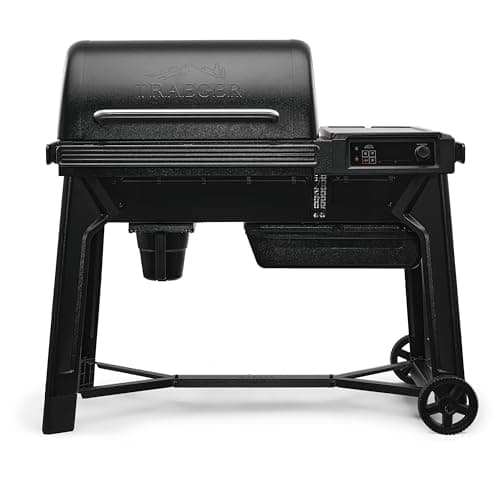
| Traeger® Woodridge | Best all-round pellet alternative — capacity and coverage a kamado cannot match | 860 sq in · 500°F · 24-lb hopper · EZ-Clean · P.A.L. rails · 10-yr warranty | $899.99 · View on Amazon Price as of October 12, 2026 |
| Weber® Searwood 600 | The closest a pellet grill gets to a kamado's sear — full-grate direct flame | 648 sq in (420 main + 228 rack) · verified 600°F DirectFlame · 20-lb hopper · 5-yr cookbox | $999.00 · View on Amazon Price as of October 12, 2026 |
| recteq Flagship 1600 | Buyers choosing a kamado for build quality — heavy 304 stainless, huge capacity | 1,667 sq in · 700°F max · 40-lb hopper · 304 stainless grates and firepot · 6-yr warranty | |
| Z Grills 600D3E | Cheapest way to get a kamado-style sear from a pellet grill | 572 sq in · rotating fire-access door for direct flame up to 750°F · 11-lb hopper | No WiFi on this model — the sear door is the reason to buy it. |
#ad — the price buttons are affiliate links and we may earn a commission at no extra cost to you. Prices come from Amazon as of October 12, 2026; the live Amazon price always wins. See our affiliate disclosure.
Traeger Woodridge
Weber Searwood 600
Running Cost: An Honest Comparison
Fuel favours the kamado and it is not a close call. A pellet grill burns roughly 1-2 pounds of pellets per hour at 225°F and 3-4 pounds per hour at 400-500°F, so a twelve-hour brisket consumes something like 15-20 pounds of pellets. A kamado can run most of a day on one load of lump charcoal because the ceramic is doing the insulating rather than the fire doing the compensating. Add the pellet grill's electricity draw — small, but real, and absolutely required — and the kamado is the cheaper cooker to feed.
What the pellet grill buys with that fuel is attention. Twelve hours of vent-watching has a cost too; it is just not on a receipt. Our how many pellets does a pellet grill use guide breaks the pellet side down by temperature and cook length.
Who Should Buy Which
Buy a pellet grill if: you want barbecue without a hobby; you cook for more than four people; overnight or workday cooks matter; you want app control and probe alerts; you want the lowest learning curve of any smoker; or you are coming from a gas grill and want the convenience to feel familiar.
Buy a kamado if: high-heat pizza and hard searing are core uses; you want the most assertive smoke flavor; you have no reliable power where you cook; you cook for two to four people; you want a cooker with essentially no electronics to fail; or fire management is part of the appeal rather than a chore.
Buy both if you can — which is more common than it sounds, because they genuinely complement each other: the pellet grill runs the long cooks while the kamado does pizza, steak and anything that needs serious heat.
Frequently Asked Questions
Is a pellet grill or a kamado better for smoking?
A pellet grill is easier; a kamado's smoke is stronger. Set-and-forget PID control against lump charcoal and wood chunks — pick based on whether you want repeatability or intensity.
Does a kamado get hotter than a pellet grill?
Yes, substantially, at the top end. Most pellet grills stop at 450-500°F. The exceptions are sear-focused models like the Weber Searwood (verified 600°F full grate) and the recteq X-Fire Pro 825 (verified 1,250°F in grill mode).
Which is cheaper to run?
The kamado, on fuel, by a wide margin — ceramic heat retention means one charcoal load runs a long cook, while a pellet grill burns 1-2 pounds per hour at 225°F and needs mains power.
Can you leave a kamado unattended like a pellet grill?
Not in the same way. A pellet grill corrects itself; a kamado holds temperature through mass and vent position with no feedback loop.
Which has more cooking space?
The pellet grill, substantially, for the same footprint. A kamado's round grate inside thick walls costs a lot of usable area.
Our Recommendation
For most people reading a pellet-grill site, the pellet grill is the right answer — and the Traeger® Woodridge is the clearest expression of why: 860 square inches, a 24-pound hopper, a 500°F ceiling and a 10-year warranty, with none of the fire management. If the kamado's appeal is specifically searing and pizza, the Weber® Searwood 600 is the pellet grill to compare against, because full-grate direct flame at a verified 600°F is the closest the category comes. And if what you actually want from a kamado is a cooker built to outlive you, look at the recteq Flagship 1600 and its 304 stainless construction before you commit to ceramic.
Where a kamado still wins outright: top-end heat, smoke intensity, fuel cost and working with no electricity. Those are real advantages, and no pellet grill at any price erases all four.
Where to buy the Traeger Woodridge
Prices come from Amazon at the time stamped on the button and change often; the live Amazon price always wins. We may earn a commission if you buy through this link.
#ad — the buttons on this page are affiliate links and we may earn a commission at no extra cost to you. See our affiliate disclosure.
Explore more: Pellet Grill vs Charcoal | Pellet Grill vs Offset Smoker | Best Pellet Grill for Pizza | Best Pellet Grills