
Can You Leave a Pellet Grill Unattended? What's Safe and What Isn't
The Short Answer
Every pellet grill manual tells you not to leave the grill unattended, and that is the only answer with no risk attached. In practice, a modern pellet grill is the most unattended-friendly smoker ever sold, and the difference between a safe long cook and a bad one is almost entirely preparation — grease, pellets and siting — rather than luck.
Here is the honest version that manuals cannot print. The whole point of a pellet grill is the twelve-hour cook: a PID controller measures the cook chamber and adjusts pellet feed and fan speed to hold the temperature you set, the fire stays inside a steel fire pot, and nothing requires you to open the lid. That is why overnight brisket is the signature pellet-grill cook and why millions of people do it. It is also why the failure modes are specific and preventable rather than random.
This guide covers what actually goes wrong, the checklist to run before you walk away, and the features worth buying if unattended cooking is the reason you own the grill.
What Actually Goes Wrong
Four failures account for nearly everything, and only one of them is dangerous.
1. The hopper runs empty. The most common unattended failure by a wide margin, and completely harmless: the auger has nothing to feed, the fire dies, the chamber cools and your cook stalls. You lose the meal, not the grill. A pellet grill burns roughly 1-2 pounds of pellets per hour at 225°F and 3-4 pounds per hour at 400-500°F, so the arithmetic is easy — see our pellet consumption guide for the full table.
2. The auger jams. Damp pellets swell, bridge in the hopper and seize the auger. Same outcome as an empty hopper, same lost cook. This is the single best argument for keeping pellets dry and sealed; our how to store wood pellets guide covers it, and pellet grill auger jam covers the fix.
3. A flame-out followed by a relight. If the fire goes out while the auger keeps feeding, unburned pellets pile up in the fire pot. When a hot ember or the igniter relights that pile, you get a sharp flare — the "puff" pellet-grill owners talk about. It is loud and can blow the lid open; it is rarely destructive, and modern controllers with flame-out detection shut down rather than keep feeding. Our pellet grill flame-out guide explains the causes.
4. A grease fire. The only failure on this list that becomes a real fire. Grease pools in the drip tray, the grease channel and the bucket, and a high-temperature cook or a flare can ignite it. This is entirely a maintenance problem and entirely preventable, which is why the checklist below starts with it rather than ends with it.
Notice what is not on the list: the controller spontaneously running away, or the grill catching fire for no reason. A pellet grill that is clean and fed is a remarkably stable machine.
The Pre-Walk-Away Checklist
Run this before any cook you do not intend to watch. It takes five minutes and it addresses every failure above.
- Clean the grease path. Scrape the drip tray or replace the liner, empty the grease bucket, and check the channel the grease runs down. If you cannot remember the last time you did this, do not leave the grill. Our how to clean a Traeger grill walkthrough is the full routine, and drip tray liners make it a 30-second job.
- Vacuum the fire pot. Ash accumulation smothers the fire, and a smothered fire is how flame-outs start. Every few cooks is enough for most grills.
- Use fresh, dry pellets, and fill the hopper. Not topped up — full. Then do the arithmetic for your cook length at your temperature, and if the numbers are close, plan a refill rather than hoping.
- Site the grill properly. On a non-combustible, level surface, with clearance on every side, and not under a wooden eave, vinyl siding, a pergola or a low deck rail. This single step converts the worst-case grease fire from a house problem into a grill problem.
- Set alarms, not timers. A meat-probe target alarm tells you when the cook is done. A low chamber-temperature alarm tells you when something has gone wrong — that is the one that matters at 2am.
- Check the power path. Outdoor-rated outlet, outdoor-rated cord if you must use one, nothing lying in a puddle. A pellet grill is useless without electricity; our electricity guide covers draw and backup options.
- Read the weather. High wind both cools the barrel and moves embers. A storm forecast is a reason to cook another day, or at least to stay home.
- Keep pets and children away from the grill. The obvious one everybody skips. A knocked-over grill is a far more likely emergency than a controller failure.
What to Look For in a Grill You Intend to Leave
If unattended cooking is the reason you are buying, four features do the work:
- A hopper over 20 pounds. At 225°F, 24 pounds is a comfortable overnight and 40 pounds is more than you will need. A 10- to 18-pound hopper means planning a refill.
- A pellet-level sensor. It converts "I hope there are pellets left" into a phone alert. Only mid-range and premium grills have one.
- WiFi with temperature alerts. The feature that turns a silent failure into a notification. See our best WiFi pellet grill picks.
- Double-wall or insulated construction, if you cook in the cold. A single-wall barrel in winter burns more fuel and swings wider, which makes a long cook less predictable. An insulation blanket is the cheap retrofit.
And one piece of gear matters more than any grill feature: a thermometer with alarms. A grill that reports its own chamber temperature is good; an independent probe that screams when the chamber falls below a floor you set is what actually wakes you up.
Our Picks for Unattended Cooking
| Pick | Best for | Key specs | Price |
|---|---|---|---|
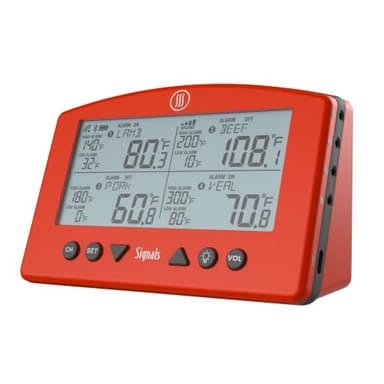
| ThermoWorks Signals | The best alarm setup — multiple channels, app alerts, big cooks | Multi-channel probe thermometer · app alerts · our best multi-channel pick | $259.00 · View on Amazon Price as of October 12, 2026 |
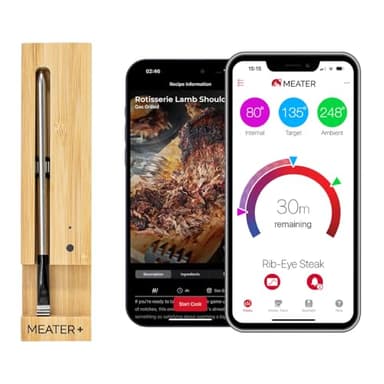
| MEATER Plus | The cheapest useful overnight monitor — internal and ambient in one probe | Fully wireless probe · reads internal + ambient · Bluetooth app alerts | |
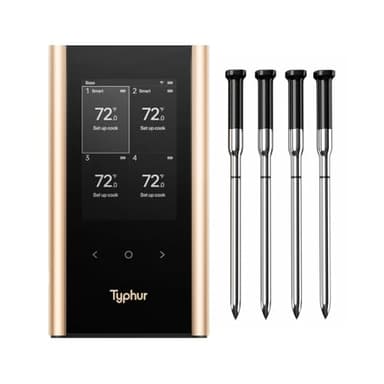
| Typhur Sync Gold (4 Probes) | Four cuts at once with no cables through the lid | 4 fully wireless probes · charging case · app alerts | |
| Traeger® Woodridge Pro | The grill built for walking away — pellet sensor plus WiFIRE alerts | 970 sq in · 500°F · 24-lb hopper with pellet sensor · Super Smoke · 10-yr warranty | $1,149.99 · View on Amazon Price as of October 12, 2026 |
#ad — the price buttons are affiliate links and we may earn a commission at no extra cost to you. Prices come from Amazon as of October 12, 2026; the live Amazon price always wins. See our affiliate disclosure.
ThermoWorks Signals
MEATER Plus
Typhur Sync Gold (4 Probes)
Traeger Woodridge Pro
A fourth option worth knowing about if budget is the constraint: the Inkbird IBT-4XS is the budget Bluetooth pick in our thermometer roundup, and a cheap alarm is worth vastly more than no alarm.
How Far Is Too Far?
A reasonable scale, from what experienced owners actually do:
Leaving the property for a few hours during a daytime cook. Common and generally sensible on a clean grill with a full hopper, a sited grill and phone alerts. The worst realistic outcome is a stalled cook.
Sleeping while the grill runs overnight. The signature pellet-grill cook. Do it on a grill you have cleaned, with a low-temperature alarm set, and with the grill away from the structure. Most of the people telling you pellet grills are safe overnight are describing exactly this setup.
Leaving the house overnight, or going away for a day with the grill running. This is where we would stop. Not because the grill is likely to fail, but because the one failure that matters — grease — needs someone within reach, and because a flame-out at hour three wastes a brisket you are not there to rescue.
Running unattended in a storm, in high wind, or with a grill you have not cleaned in a season. Don't.
What the Manufacturers Say, and Why
Every manual in the category says do not leave the appliance unattended, and it is worth understanding that this is not boilerplate for its own sake. A pellet grill is a fire inside a metal box on your property, powered by mains electricity, with a reservoir of combustible fuel attached. The manufacturer cannot know whether your grill is clean, whether it is three feet from vinyl siding, or whether your pellets have been sitting in a damp garage since last summer — so the instruction has to be absolute.
Treat the manual as the baseline and the checklist above as what you add when you choose to go beyond it. If you want the shortest version: grease is the danger, pellets are the inconvenience, and alarms are how you find out about either.
Frequently Asked Questions
Can you leave a pellet grill unattended?
Manuals say no, and that is the risk-free answer. In practice a clean, properly sited pellet grill with a full hopper and phone alerts is the most unattended-friendly smoker made, and long daytime cooks while you are elsewhere are routine.
Can you run a pellet grill overnight?
Yes, and it is the main reason people buy these grills. Clean the grease path first, fill the hopper with dry pellets, site the grill away from the house, and set a low chamber-temperature alarm.
What actually goes wrong?
An empty hopper, a jammed auger, a flame-out and relight, or a grease fire. Only the last is dangerous, and it is purely a maintenance problem.
Do you need a WiFi pellet grill?
No, but alerts change the risk more than any other feature. A separate wireless thermometer with a low-temperature alarm gets you most of the benefit for less money.
Is it safe to leave a pellet grill unattended in the rain?
Light rain is generally fine with the lid and hopper closed. Protect the outlet and cord, keep pellets dry, and do not leave a grill running unattended in high wind or a storm.
The Bottom Line
A pellet grill is designed to be left alone — that is the product. The risk that remains is not the electronics or the controller; it is grease you did not clean, pellets that got damp, and a grill parked against the house. Clean the grease path, fill the hopper with dry pellets, move the grill clear of anything flammable, and put a ThermoWorks Signals or a MEATER Plus alarm on your phone. If you are buying a grill specifically for overnight cooks, buy hopper capacity and a pellet sensor before you buy anything else — the Traeger® Woodridge Pro is our pick for exactly that job.
Check the live price on our top overnight-cook monitor
An alarm is the cheapest safety upgrade in pellet grilling — the button reads the current Amazon price.
#ad — the buttons on this page are affiliate links and we may earn a commission at no extra cost to you. See our affiliate disclosure.
Explore more: Pellet Grill Flame-Out | How Many Pellets Does a Pellet Grill Use | Best WiFi Pellet Grills | Traeger Maintenance Schedule